Showing posts with label Pure O. Show all posts

Thursday, April 4, 2019

OCD A to Z: R is for Relationship OCD

clear the air detail copy


I'd never seen the acronym ROCD before until I came upon it on a OCD self-help list called Stuck in a Doorway. It stands for Relationship OCD, and another one was HOCD for Homosexuality OCD. They are both ways that OCD latches onto whatever is important to us.

OCD wants definitive answers, and when an obsessive thought or question centered around being with the right person(ROCD) or gender(HOCD), my desire was to answer the questions so I could breathe, so I could not be vigilantly checking to make sure I was making the right decision, and not be haunted by it later.

I was shy, and didn't date in highschool. I had a friend who lived in a cooperative community and most of her mother's friends were lesbians. This friend and I loved talking about big questions, the meaning of life, the nature of history. She gave me feminist theorists to read, and I gave her books by Madeleine L'Engle and C.S. Lewis. She didn't believe in God, but I wanted to be a minister, but we still talked for the enjoyment of spirited talking. She didn't date either, and rumors abounded that she was a lesbian. We went to see Entre Nous, a French movie about a woman who leaves her husband for another woman. This haunted me, because my father had left my mother that year, when I was 16 and my sister 13. My friend said that this woman as becoming free, but I kept seeing the shot of the daughter waiting for her mother.

I moved away after I graduated, and she gave me 3 cassette tape of "Womyn's Music" to listen to, Meg Christian, Ferron, Chris Williamson, Sweet Honey in the Rock, and I loved the songs. Reading about women in history was one of the few things that kept my interest in college, and I ended up majoring in feminist theory, but slowly this evolved into a way to try and figure out if it was safe to be with a man. I had fallen in love, with a man, and my OCD was tenaciously throwing out barbed questions that perhaps I was a traitor to my gender. I wondered if the feminist songs I loved meant I was a lesbian, or the many women friends I felt safe with or found attractive meant that as well.

In spite of all this rumination, and reading and analyzing, I agreed to marry the man I was in love with, at age 25. My OCD fears were that marriage was inherently dangerous, and I would be mocked by those who came after me for being part of that institution. It took all I had to carry through when we went to apply for a marriage license, and the form said that $25 of the fee went toward a fund for victims of domestic violence. I didn't know I had OCD, but I knew I was filled with anxiety, and I clung onto the fact that I couldn't imagine being with anyone else, and that I had to ride through the anxiety, and that without getting married, I would have no health insurance after I graduated.

I used to wonder if I was suppressing my "true" self by being with my husband, but the exposure of being married, and enjoying his company until the anxiety subsided helped my obsessing about this to recede to the background as my health anxiety and perfectionism came to the forefront and sucked up much of my energy and life.

After I had my hair cut short, I remember some people calling me a boy, but how I looked didn't determine who I was. My fears didn't determine who I was. The healthy part of me knew I loved the man who became my husband.

If you've read this far, take courage. OCD can be treated with Exposure Therapy. You can learn to listen to the voice within you that knows who you are. You can learn to deal with your evolving self. No one gets a lifetime guarantee that they've chosen the right person or right gender. Just look at the divorce rate. OCD compulsions of analyzing and checking and figuring out will corrode a relationship, causing the very thing we fear, the loss of love, the fear of haunting memories.

Monday, April 1, 2019

OCD A to Z: O is For Only Obsessions

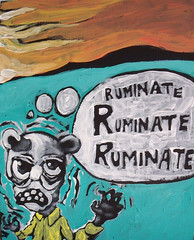
ruminate

When you don't appear to have any physical rituals, it seems very logical to assume that you only have obsessions, and no compulsions. This is where the "Pure-O" label originates, in the idea of being purely obsessional. What I have discovered in treatment is that compulsions or rituals that take place in my mind are every bit as real as those that are visible to the rest of the world.

Compulsing is the glue that makes an obsessive thought stick(after the initial hit of relief). It reminds me of times I have tried to fix something I perceive as a flaw, and ending up making it worse, because the thought of walking away without trying to get rid of it seems too anxiety-provoking. There are some thoughts that if I imagine letting them pass, I get very anxious, because I must make sure they aren't true, or I believe they say something about me as a person.

If I get involved in the battle against them, I lose every time. Going over conversations in my mind, reconstructing what I said, analyzing, ruminating, mental acrobatics. I left a comment on a friend's facebook wall and suddenly thought "What if this is rude?" and my urge was to try and establish if it was indeed rude, over and over. In the past I would've gotten stuck on this and lost a chunk of my day, or tried to find a way to see if the other person thought it was rude and on and on.

Other of my rituals actually are physical, but I never thought of them that way. Looking things up on the internet is an actual activity, as is avoiding certain things(for years I didn't watch the news or listen to the radio), or long sessions of writing in my journal analyzing everything.

Once I learned to identify my compulsions, it was easier to figure out what an exposure was, and what "response prevention" means in Exposure and Response Prevention therapy. So, I accepted that my facebook comment may have been rude, felt some anxiety, and moved on instead of analyzing every angle, and the anxiety moved on as well.

[Revisiting OCD A to Z from 2011]

Sunday, November 4, 2018

OCD A to Z: E is For Exposure and Response Prevention Therapy(ERP)

Stacy Nichols - Exposure Therapy 20" x 34"

When I first realized I had OCD, about 7 or 8 years ago, I joined the International OCD Foundation and started receiving their newsletter. As much as I learned from the excellent articles, I assumed that Exposure and Response Prevention Therapy(ERP) wouldn't work for mental obsessions, things happening in my head. Thoughts seem like the substance of our minds, unmovable. Another E word that came to mind was "endless," as a way to describe the thoughts that hang on like thistles on your socks after a hike.

But ERP does work as a treatment for mental obsessions, Pure O, intrusive thoughts. I am so much better than I was before I started ERP 4 years ago. Yes, at first it seemed like trying to see through muddy water, and having an experienced Exposure therapist helped me get far enough away to see the patterns and processes of the OCD.

In a nutshell, ERP is exposing yourself to a thought you don't want to have, or situations that evoke that thought, and then preventing yourself from responding with compulsions in order to make your anxiety go away. So if I have the thought that the ache in my side is appendicitis, which strikes fear into my heart, because I need to know for sure, and right now, an exposure could be saying "Yes, I may have appendicitis. I don't know for sure," and response prevention could be staying off google, not researching the symptoms, or calling my doctor, or going to the emergency room, or poking at my side to see if it still aches. And the ultimate result will be less sensitivity to that thought, an ability to let it float in and out, and continue on with my life.

I encourage anyone who suffers from mental obsessions to seek out an ERP therapist. Check the IOCDF's list of therapists, and also their list of OCD support groups. And read Jonathan Grayson's Freedom from OCD. He published some articles in the IOCDF newsletter about obsessing about obsessing which finally led me to seek help for my OCD.

[Revistiing OCD A-Z from 2011]


Related:

History of Exposure Therapy

Exposure Scripts for Pure O and Health Anxiety

Friday, August 16, 2013

Google Doesn't Have the Answer for Every OCD Fear

Uncertainty

This photo is called Uncertainty by Rieke Photography.  From the time I had access, over 20 years ago, I was searching on the internet for answers to my uncertainty.  I know the feeling of the keys under my fingers, the gentle give of each key when I depress it, the hope that I will get THE answer for my fears.

For a long time, I was glad I had dial-up because at least I was thwarted in compulsive web searching at home, even though I still had it at work.  The fact that I have high-speed internet at home now, and do not spend all my time searching, is quite amazing to me.  

In the thick of my OCD, before I got any treatment, I couldn't imagine stopping my searches.  If I had a health symptom, I searched for answers.  If I was trying to figure out an unanswerable question, I searched for answers.  I remember when Google first appeared.  I was a librarian, and word spread fast that there was this new search engine with a magical algorithm that worked exceedingly well.

But even Google couldn't solve my OCD, because the reassurance I was seeking was a mythical oasis that vanished as soon as I got close.  I will grant though that it was through Google that I found the International OCD Foundation.  I joined, and started receiving their newsletter.  The irony is that I subscribed to the newsletter for 5 years, all the while compulsively searching about OCD, instead of seeking treatment.

Eventually, when I reached my lowest point in 2006, I finally put it together that Exposure Therapy might work for my mental obsessions and health anxiety, and found an Exposure Therapist.

Part of my Exposure Therapy involved stopping a search before I felt "done" and staying with the wave of anxiety until it ebbed.  There are still days when I am feeling stressed, and search Google as a way to dull the anxiety, but it is not my default position, hands poised on the keyboard.


Monday, August 6, 2012

Intrusive Thoughts and Harming Fears: A Review of I Hardly Ever Wash my Hands: The Other Side of OCD by J.J. Keeler


TLC Book Tours contacted me about reviewing J.J. Keeler's I Hardly Ever Wash My Hands: The Other Side of OCD, and I was intrigued by the title because my OCD doesn't manifest in handwashing rituals, and this is the short-cut metaphor for OCD much of the time.  After reading the book, I felt like I'd found an OCD-Soul-Sister and although I am never glad that someone else has OCD, and I am glad when they can write about it in an articulate and insightful way.  

I had to laugh when J.J. Keeler describes how her twin sister had hypochondria with fear of many diseases(a type of OCD I am very familiar with), but the author had only "had" one disease: AIDS.  In the irony of OCD, in elementary school she is triggered into worrying about AIDS when her parents mention a blood transfusion she had, but what her OCD latches onto is the risk of "dirty needles" which in her young mind means thumbtacks, staples, pine needles, with dirt on them.  Humor is a major component of Keeler's account of OCD, grabbing the edge of ridiculousness about OCD fears and pulling the whole thing apart, so that the sufferer can catch a glimpse of OCD's game of generating endless scenarios and holding life hostage.  

The second chapter, The Bomb in my Teddy Bear, is a marvel of encapsulating the experience of morphing OCD thoughts.  When she was 8 years old, neighbor gives her a teddy bear at a yard sale, and a chain of fears links itself around her.  She started getting a weird feeling about the bear, and wondered why a relative stranger would give her a teddy bear for free.  Then it came to her, "The reason was obvious.  There was a bomb in the teddy bear."  Keeler agonized over how to dispose of the bear, without harming anyone else, and then when it didn't explode, wondered if the neighbor would come back to finish the job.  Her rituals to keep the anxiety from exploding were a constant stream of "figuring out" and "analyzing" combined with tin cans at the door to let her know if there was an intruder, and plotting how she could take the bear on one of her father's fishing trips and throw the bomb overboard.

Eventually, OCD moves onto other topics in Keeler's life, but the same corrosive fear and desperate maneuvers to make the fear go away.  In addition to fears about AIDS(and calling the testing center before her test was even received, to check, check, check), she feared causing harm to others after being deluged with intrusive thoughts.  If you suffer from this very painful form of OCD, please read this book.  Keeler has known the despair that made her consider suicide, because she didn't want to harm anyone and yet these images would pop into her head, and she has survived, and now thrives.  

The most difficult part of reviewing I Hardly Ever Wash My Hands: The Other Side of OCD, is that I want to quote everything, but it would be better for my readers to go find a copy of this book and read it for themselves.  

Read J.J.Keeler's Introduction to Harming Obsessions on her blog.  

Related Post:


http://tlcbooktours.com/

Monday, May 21, 2012

Living with Me and My OCD: An Interview for Claire's Documentary


ClaireJaneOCD on twitter is creating a documentary about the experience of having OCD, and invited me to contribute a video.  Claire and Jane are twins in the UK, who just completed running a marathon in order to bring awareness about OCD.  This is my first time recording myself!  And definitely an exposure to make it, but hopefully will be helpful to other people who struggle with OCD.

Friday, April 1, 2011

Pure O: How do I tell the difference between obsessions and compulsions?

Bacterial capture by Neutrophil NETs

There's been discussions lately on the OCD support lists about how to tell the difference between an obsession and a compulsion, if it's all thoughts, as in "Pure O." My understanding is that the initial thought is the obsession, and the cascade of thoughts afterwards are the compulsion. For me it would be something like, "What if I said the wrong thing?" as the obsession, followed by trying to figure out if I did indeed say the wrong thing, including retracing my words, trying to account for all of them, which is the compulsion.

The irony is that the compulsion is supposed to be what reduces the anxiety produced by the obsessive thought, and yet, when I used to say "I wish I could stop obsessing about this" what I really meant was the whole flood of compulsions. I fly into compulsing so quickly that it seemed quite dubious that the initial thought was causing the anxiety--surely all the retracing, figuring out, analyzing, and research were the obsession right? How could they possibly be a way to lower my anxiety??

But what I learned during exposure therapy was that compulsions only provide short term relief, and in some cases, very very short term, and then they rebound with their own additional suffering, taking up mental space and energy, and that if I challenged myself to refrain from figuring out an obsessive thought, that my anxiety level immediately spiked, and that was a sign that the compulsion was serving its function of a short term hit of relief, even if I couldn't see it as it happened.

My husband had the flu this week, and he gave this analogy--the virus is the obsession, and the immune system response is the compulsion. When we are sick, what makes us feel lousy isn't the virus itself, but the attack of the immune system on the virus. In the case of our bodies, for the flu or other illnesses, we actually want the immune system to attack, but OCD is more like an allergy, where our immune system attacks something harmless like pollen, mistaking it for an invader. I know the things we obsess about don't seem harmless, and that they are often about things important to us, but our full blown compulsions cause us more misery in many cases than the initial obsession.

In the midst of my worst OCD flare ups, I had glimpses of how destructive the compulsions were, but I was so scared by the obsessive thought that I clung to my compulsions. I finally hit a low point with my health anxiety, that even though I was terrified of getting treatment, I knew I couldn't continue on the way I was going and have any kind of life. If you are like me, you probably also spend time trying to figure out if something is an obsession or a compulsion, and wanting to know for sure which it is. Another lovely complication of the OCD! Take your best guess.

Monday, January 17, 2011

Finding a therapist for "Pure O" OCD: 5 Things to Watch Out For


I was in psychodynamic therapy for 6 years with a therapist who said I had OCD, but who didn't have a plan to treat my OCD beyond having me avoid my triggers. Previous to that I had several other therapists who didn't really have a clue about my OCD. Here are some things to watch out for--hopefully this will help you find help more effectively and not have to go through the delay I experienced in finally getting Exposure and Response Prevention(ERP) therapy.

  1. Affirmations. If a therapist tells you to repeat affirmations about being a good person, good father, good teacher, good Christian, good whatever, in order to counteract scary, violent, disturbing thoughts, this just feeds the fire, prompting ever more desperation in trying to prove it to yourself that you are not a monster or a danger to others. This is different from having a compassionate therapist who asserts your value as a human being and encourages you to take your life back from the OCD and any other negative deeply held beliefs about your worth, by doing exposure therapy.
  2. Deeper Issues. If a therapist tells you there are deeper issues you need to deal with, and then somehow your OCD thoughts will resolve or disappear once you've dealt with the issues, you can be in for a long long stint of therapy. Yes, there may be deep issues in your life, but resolving them is not a treatment for OCD, since the compulsions often complicate any attempts at resolution, and even if you gain a deeper understanding of your psyche, OCD can be incredibly resistant to magically disappearing.
  3. Thought Stopping. Snapping a rubber band everytime you have an unwanted thought, or imagining a giant stop sign will sensitize you to the thoughts even more. Mental compulsions, on the other hand, can be stopped(even if it seems impossible), which leads to the next point.
  4. Confusing obsessive thoughts with compulsive thoughts. Pure O isn't pure. I discovered with the help of my ERP therapist, that I have mental compulsions for trying to "undo" my intrusive obsessive thoughts, like freezing(and doing nothing until I solve the issue), retracing my thoughts or actions, analyzing, figuring out, avoiding all reminders of the thought, or researching.
  5. Disputing the thoughts ad infinitum. Cognitive Behavioral Therapy(CBT) is the larger category that ERP belongs to, but CBT applied to mental obsessions without an understanding of the nature of intrusive thoughts, perfectionism and "just right" feeling can turn dysfunctional thought analysis into compulsions. I would get sidetracked into figuring out whether I'd done a thought record thoroughly enough, and even if I disputed all the errors in my thinking, it didn't seem to stick.
Related Post
Finding a good therapist for OCD in the US and Canada

Friday, December 31, 2010

Dealing with Feared Consequences When they Happen: The Impossibility of Coming Out in Advance

What's Right Around Us

A post by Pure O Canuck got me thinking when she about her relationship OCD(ROCD) and homosexuality OCD(HOCD),
When does this horrible urge/need to find the answer end? And why does it seem like others have found the answer and I can't? It seems like others are living happily ever after. Can I say that I feel that way about my relationship at the moment? Definitely not. (Spend too much time on that and the ROCD starts up - but that's for another post.)
This desire to live happily ever after is seductive for all humans, and when you have OCD, there can be a gnawing, erosive need to figure out if you actually are living happily, or whether you have made a huge mistake in who you choose to be with by compulsively analyzing or avoiding all triggers of the fears. I read lots of "coming out" stories in college(which is one of Pure O Canuck's exposures right now), and I longed for the click, the final puzzle piece going into place, the revelation or vision that these stories seemed to offer. But I am realizing that the OCD is latching onto the metaphor of "coming out" as a form of absolute certainty, which in actuality it is not, and OCD is very opportunistic and picks up on other images like being "in denial about being gay." As Pure O Canuck says,
I know that I am not going to get an absolute, certain answer to these questions. (I don't quite understand why - it seems like others have it. But I guess that's just a momentary feeling and it will come and go.)
It's hard to accept that other people seem to have absolute certainty, and there's a longing to have some of that elixir, but in reality, people without OCD may simply be able to move on in spite of some uncertainty, rather than seeking to eradicate every last remnant. Others were indeed in denial about being gay because of strong cultural and religious pressure and condemnation, but eventually reached a point where they came to accept who they were, in spite of trepidation or fear, and often sound at peace, but this isn't the same thing as absolute certainty. OCD never grants peace in the long term. If I feed my OCD with figuring out, analyzing and avoidance, even if one obsession recedes, another one will appear.

My therapist likes to say, "If your feared consequence happens, you'll deal with it then. You don't need to know the answers to your OCD questions right now." That's the basic uncertainty--the women in some of these coming out stories didn't know that they would suddenly fall in love with a woman--but if they didn't have OCD, they dealt with it when it happened, not in beforehand rumination.

I did the exposure of marrying my boyfriend, my now husband, in spite of agonizing whether I was really lesbian, and might never truly be happy, and over the years have grown to love my husband more and more, but I had to deal with a burst of anxiety about whether I loved him "enough" and when our 10th anniversary came, and we planned to renew our vows, I had a panic attack about whether I really could say "until death do us part"(which totally misses the point that I already had taken that vow the first time around!!) OCD narrows our vision, and allows no possibility of grace or peace.

Tuesday, November 30, 2010

Field Guide to OCD: Feeling on Trial

Courtroom
I feel like I'm on trial by OCD. This is one of the clues to recognizing being in the OCD. The OCD thrusts the burden of proof on me. I must prove all things beyond any reasonable doubt, which of course, OCD doesn't ever recognize. When I started Exposure Therapy, my OCD had a lot of power and credibility.

Right now, I am on the computer, after being on Skype. I called at 8:00 am, the time I used to start work when I was employed, and once I got off the phone, I was back in my old work pattern of compulsion, which was to stay on the computer, in a kind of trance, because anything else I might do could be the "wrong" thing, and I would be in for harsh cross-examination from my OCD thinking. I'm doing my mental rituals of checking of what time it is, how many minutes have passed, diverted into the "why am I doing this? What is wrong with me?" line of questioning, followed by, "you can't undo this. you've ruined your day, you can't salvage it. you suck."

This adversarial mode adds more fuel to the OCD fire. And OCD talks a confident way, a dictatorial, demanding way that is intimidating, and uses a kind of brute force, saying the same thing over and over, louder and louder. What if! What if! What if!

A cross-examination complete with, "Just answer the question. Don't explain. Just answer yes or no. Strike everything else from the record." What if I am fucking up my life? What if I am making a horrible mistake? What if I really am bad? What if I don't really deserve any compassion? What if I am wasting my life and this is unforgiveable? What if I am beyond redemption?

Often my own thinking seems pallid and inconsequential, signifiying nothing, powerless. But it's my own thinking that allowed me to get into treatment, and start doing things with my life, and learn to have compassion for myself. This is the act of faith, to trust the quiet still voice, without knowing for sure if it really is my own thinking--the OCD chips away at that too, demanding I know for certain if I'm thinking for myself or if it's OCD.

This is crazymaking stuff. Depending on the context, the my current line of questioning can completely contradict another line of questioning from just a second before. From "Don't trust your thinking" to "What's wrong with you that you don't trust your own thinking?" to "Ok. But are you sure this is your own thinking and not the OCD?"

What is the fruit of your OCD? What kind of fruit does it bear? Does it bring peace or joy or meaning to your life? If I am brave and take a minute to observe, I can see the destruction it wreaks, the poisonous fruit OCD bears, the mess my life became when I was totally in grips of it. OCD certainly promises peace, and promises if I just stay at the computer and answer all the questions, that I will avoid the turmoil of getting up, and facing my day in a backlash of obsessiveness, but I know from experience, if I stay on the computer a few more hours, until my back hurts, and I've thoroughly exhausted myself and my mood has deteriorated, that any peace I get is an illusion.

Monday, May 17, 2010

Am I still anxious? Does this still bother me? And other querulous questions.


It's as if I am poking someone who is sleeping, and saying "Are you sleeping?" poke, poke, poke, and then they wake up. The mental ritual of checking on my anxiety level or sensations is one of the hardest to deal with. I'm sure that some of those reading this blog have had the experience of being consumed by anxiety about a particular obsession or topic and then getting up the next day and the anxiety is gone. I assumed that once anxiety set in, only sleep could fix it, and I would long for it to be the next day.

Even more frustrating is waking up calm, and then remembering my anxiety from the day before and having it all kick up again. My immediate response when remembering an old worry is "Damn, there it is again. Why can't I get it to go away?" It's like a staticky bit of plastic that you try to flick into the trash, and it just clings to your fingers. This is followed by having the urge to check if I am still anxious or if a certain symptom or thought still bothers me, and the more I check, the more entrenched it gets.

I would recognize anxieties that would probably fade the next day, like fear that I'd chosen the wrong dish off a menu, and I'd be frustrated by my inability to step away from it sooner armed with this knowledge. Knowledge alone is not a match for the anxiety created by OCD. My theory is that sleeping would give me a break from poking at the anxiety, waking it up, and increasing its noisy dominating behavior. It wasn't a magical cure.

My therapist has encouraged me to let my anxiety producing thoughts into my mental space, letting the noise happen, in fact practicing introducing the noise into my mind, which is an exposure. I usually feel snarly when he suggests this, but I also recognize that the vigilant checking to make sure the intrusive thoughts aren't there repeatedly reminds me of them. And every "Damn there it is again," highlights the thought, magnifies it, makes me exquisitely sensitive to even the threat of a particularly despised thought.

I know this sounds crazy. If you are desperate to avoid a scary thought, and you forget it for a few hours, the last thing you want to hear is the idea of purposely seeking it out, and disrupting that bit of peace. But the peace is fleeting and leads to long term anxiety--I have never been able to force a thought out and make it stay out for good. I have learned that it is possible to enjoy life even with those thoughts making noise.

Monday, February 8, 2010

OCD Toolbox: Freedom from Obsessive Compulsive Disorder by Jonathan Grayson

This book, Freedom From Obsessive Compulsive Disorder: A Personalized Recovery Program for Living with Uncertainty by Jonathan Grayson, was very important in moving me to get help for my OCD. I'd spent a lot of time reading about OCD, but assumed that because much of what I dealt with took place inside my head, rather than physical rituals, Exposure and Response Prevention Therapy wasn't really for me.

Grayson went right to the heart of this by identifying mental rituals, and describing how to write scripts that expose you to your "Pure O" fears, and learn to habituate to them, and live your life. He gets the "obsessing about obsessing" quicksand of the OCD mind. And even more importantly, he introduces the concept of learning to live with uncertainty. I recognized myself in his descriptions right away, a compelling desire to have absolute certainty that a feared consequence will not happen.

OCD makes a lot of demands for omniscient knowing, for complete understanding, for predicting the future and insisting that questions be answered that no human gets answered. It sucks to accept the reality of our tenuous existence, but Grayson points out that we tolerate uncertainty in many aspects of our lives, if it is not one of our OCD triggers. He has an example of how someone who has no fear of driving takes the risk of crashing their car just go see a movie. Last week, I thought of this example when I heard that some people I know from choir were in the hospital because they had a car accident on the way to see a movie.

We take risks everyday, but often we don't think about it, because life is in itself risky, and if we wish to experience the joys that life offers, we have to keep moving. On a bad OCD day, I really hate this revelation, because the OCD insists that I can have certainty of safety if I just ritualize, and it's hard to let go of the fantasy. But the fantasy is at the expense of having a life, a kind of living death.

Another Good Book:
Rewind, Replay, Repeat: A Memoir of Obsessive Compulsive Disorder

Sunday, January 24, 2010

OCD Flashback #2: Verbatims

I was 19, and had my first boyfriend. We would have long conversations on the phone, and then after I hung up, I'd work on reconstructing the conversation in its entirety. I filled scraps of paper with keywords. If I could not remember the order in which something was said, or what brought up a particular subject, I would sit there, frozen, going over it, hoping to jar the elusive chronology loose, dredge up the missing details. If I could not remember every line, I would feel a tightening in my chest, a vertigo of fear and anxiety.

The thought of losing even the smallest scrap of conversation drove me to document everything. I was hugely frustrated when I discovered the keywords were not enough to remind me what they were about. I knew this need to reconstruct was not normal. It ate up a lot of time and mental space. I half-heartedly wrote that if I wanted to be a therapist, at least I would be very good at writing verbatims of case sessions.

I was all alone in my fears. I couldn't tell anyone what I was doing. They would think I was loopy. I was living in a new country. I was homesick. My father had left. I really never expected anyone to love me. I was afraid of losing this boyfriend. OCD latched onto this with a vengeance--Just write it all down. Capture it. Preserve your relationship by hoarding every word.

Related Post:
OCD Flashback #1


Ritualizing in my Head: Retracing

After writing the acupuncture post, I found myself retracing whole sentences in my mind as I tried fall asleep last night. I used to think this was the obsessional part, but actually it's the thought, "Maybe there's something wrong with the post," that is the obsession, and retracing is the compulsing, the ritual that I use to calm the anxiety.

As much as I hate when I start retracing, it does damp down on the anxiety. This is counterintuitive, since I've had many times in my life that I've wished to excise this repetitiveness from my brain, but to stop retracing truly does feel very scary.

And if the critical voice starts chiming in with Why can't you stop? What's wrong with you? I feel even worse. The short answer is that I have OCD, that's what's wrong with me.

I can stop retracing. If fragments of sentences pop into my head, I don't have to get into a war with them. I could even tell myself that any post I write can be "wrong"--there's no way to be certain I'll never have someone disagree with anything I write. It sucks to sit with this anxiety, but being immersed in mental rituals sucks too.

Related Post:
Ritualizing in my Head: Freezing