Showing posts with label Uncertainty. Show all posts

Tuesday, April 2, 2019

OCD A to Z: Q is for Questions

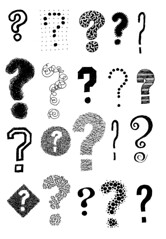
Question Marks

Questions are a defining aspect of OCD for me. Something about an unanswered question creates more anxiety for me than many statements of scary facts. "What if that bump on my ear is skin cancer?" kept me suffering more than when the doctor told me it was skin cancer, especially since I obsessed about the bump for 5 years. But then OCD in its opportunistic way turned its attention on "How could I have obsessed about this for 5 years? Why didn't I go to the doctor? What if this means I am a negligent irresponsible person?"

As a girl it was, "What if I am drafted into the army?" or "What if I can't fall asleep because I feel like I need to go to the bathroom?" In highschool I had "What if those earrings I bought my mom for her birthday look like sperm and she hates me for that?(that particular obsession seriously sucked)" and "What is that red dot on my lip?" In college it was, "What if I am meant to be with a woman rather than a man?" or "What if it too dangerous to be with a man, and I should break up with my boyfriend?"

As an adult it was "What if my beliefs are wrong? What if it really is a sin to be gay or have sex before marriage?" About this time, the internet became freely accessible, and I searched for answers to these questions, like turbo charged trips to the library reference section, searching without boundaries. I rarely asked my questions of other people. I focused on finding the answer myself, but whatever answer I found was not sufficient to stop the questions. Many questions in life have no answer, or inadequate answers, or painful answers.

OCD gave me the illusion that I could find a good answer to every question I had if I just looked diligently enough. At one point I decided it would be easier to say God didn't exist than to keep trying to find answers to my theological questions, and my therapist said that she believed God would understand how much pain I was in that I would be pushed to this point.

What kind of effect do questions have on you?

Tuesday, October 30, 2018

OCD A to Z: A is For Assurance

"Be not afraid... I will be with you always"

Assurance comes from Old Latin, to secure, to make safe. I believe it's a natural human desire to assure the ones we love, to make them feel safe, and it can seem counterintuitive to put a limit on re-assuring someone who has lots of anxiety and suffers from OCD. Assurance evokes the hymn Blessed Assurance, by Fannie Crosby and Phoebe Knapp which I remember singing in Sunday School, and loving the feeling of certainty, the exuberance of knowing something for sure.
Blessed assurance, Jesus is mine!  
O what a foretaste of glory divine!  
Heir of salvation, purchase of God,  
born of his Spirit, washed in his blood.

Refrain:  This is my story, this is my song,  
praising my Savior all the day long;  
this is my story, this is my song,  
praising my Savior all the day long.
I used to try and figure out the difference between "assurance" and "reassurance"--was I seeking information that I really needed, or was I doing a compulsion to lower my anxiety briefly, before researching again and again. I finally accepted that I can't definitively know this, that OCD is crafty in coming up with ways to bluff and say "You really need this information. You really need to search. This is new." My longing to definitively figure everything out is part of the disorder of OCD. Yes, uncertainty is painful for human beings, even without OCD, but OCD tells the lie that you can think your way through using compulsions. Reassurance doesn't last. Reassurance is a false sense of safety and security.

[Revisiting the OCD A-Z series from 2011]

Sunday, April 8, 2018

Making a Decision to Share Hope: Janet Singer of ocdtalk and her book Overcoming OCD: A Journey to Recovery


I was updating my blogroll and discovered ocdtalk's book, Overcoming OCD: A Journey to Recovery, a chronicle of finding treatment for her son Dan's OCD, and being an advocate for OCD Awareness.

She mentions her book and her blog as two decisions she agonized over in her post OCD and Making Important Decisions.

Two of the most important decisions I’ve made over the past decade are starting this blog and writing my book. I truly agonized over both of them. Who am I to write about obsessive-compulsive disorder? I don’t even have the disorder! What could I contribute that would possibly be of any value? I’m no expert. All I have are my own thoughts and experiences to share. People will laugh, or even worse, criticize me. They’ll get angry. Of course, I could go on and on. I had no shortage of reasons why I shouldn’t write about my family’s experiences with OCD.
But even with all my  misgivings, I took the plunge. I had to. I owed it to myself and my son to try to find some meaning in his suffering from severe OCD. The results have gone way beyond my wildest dreams and in retrospect, my concerns about my “credentials” almost seem ludicrous. Being an expert is not what it’s about. My main goal, from the very beginning, has been to share our story so that others will find hope, and to spread the word that OCD, no matter how severe, is treatable.

She goes on to describe doubt being the cornerstone of OCD, and this describes much of my experience. Choosing to get treatment was very difficult for me because making any choice was enveloped in a cloud of doubts and compulsive researching. Calling for an appointment with an ERP therapist in 2006 took months of rehearsing what to say, and wondering if I was making a mistake, and of course, making phone calls is one of my most dreaded things anyway.

I do not regret making the decision to call, and the decision to persevere in treatment. Writing this blog was an exposure for me as well, and like Janet, I had doubts. Having OCD didn't make me feel "qualified" to write a blog, because I believed I had to write perfectly and with absolute certainty. Every post I published was a victory for my life over my OCD. Readers found me, and it was a relief to not be alone, and satisfying to be of help by sharing my story.


Saturday, September 10, 2016

Anxiety in Creative Business: Tara Swiger and Encouragement that You Can Move Forward

This podcast on Depression and Anxiety in Creative Business from Tara Swiger caught my attention, and I wanted to write about it. Tara also sent this introduction to a follow up webinar:
Studies show that 1 in 5 adults deal with mental health issues at least once in their life.
And yet, there's so much shame and stigma about talking about this.And still, in the last few months dozens of students and friends have told me about their depression, anxiety, or struggles with their kids health.
I understand not everyone is called to talk about their experience publicly...but when we ALL stay quiet, the stigma grows strength. So today on the podcast, I'm getting honest.
You’re not alone in this.
You are NOT alone in struggling with this. And as I share, I want you to remember – whatever you’re struggling with, not only are you not alone, but you can also move forward WITH IT. Exactly as you are. People are doing it. You don’t have to be different, better, or “more together” to make a business thrive.
I have a creative business, and when I have anxiety, sometimes I come to a halt in the belief that I can't move forward WITH IT.  But the truth is I started creating art in the depths of my anxiety, and went on to start my Etsy shop in 2007 just a few months after I began Exposure and Response Prevention Therapy for my OCD.  The Exposure for me was to create the shop without knowing if it was "perfect" or the right photos, or the right descriptions, or whether anyone would ever want to buy anything. 

Tara describes how reading about intolerance of uncertainty resonated with her when thinking about her own anxiety, and this is a key theme of mine as well.  All those What If questions, the desire to know how things will turn out before they happen.

Struggling with manually creating Wordpress website for my business was the next step to realize I was compulsively researching how to do it, when in fact, I needed something simpler, and the anxiety of letting go of the idea that I needed to know how to do things before I knew how to do them.  

A turning point was at a craft show, when a woman spent a long time checking each of my items for the most "perfect" one.  The piece that the craft show customer liked the best wasn't the most flawless in her eyes, so she told me she was choosing another one that had no visible defect.  Talking with my ERP therapist, I recognized myself in this woman.  Shopping for anything would drag on because I couldn't decide if a "flaw" would mesmerize me forever or eventually fade, and I would get angry at myself for latching onto such tiny things.  

It was huge to know I was making imperfect art, but that I wanted to do it anyway.  That I did not want to walk away from something I truly loved, because it was flawed.  I now work full time in my creative business, and yes, when anxiety flares up it is difficult, but part of the difficulty is in believing that I must entirely banish the anxiety to accomplish anything, and that it is a sign that I am a "bad person" if I feel anxious. The underlying premise of Exposure Therapy is that you can move forward through the anxiety, that it is possible, and for this encouragement, I am grateful. 


Monday, August 4, 2014

Making Room for Your Life: TEDx Lincoln Talk with Khara Plicanic


I came across Kara Plicanic on Instagram.  She is a wedding photographer with a creative eye, and I was intrigued that she had done a TEDx talk called Anything is Possible ~ and That's the Problem.  Or is it? about her experience with OCD.

She recommends reading Jeff Bell, and I concur that he is an eloquent writer and speaker about facing OCD and making a life.

It helps to find kindred spirits who are artists as I am, and who have made room for their creative spirit amidst the crowding of OCD thoughts.

Monday, February 3, 2014

Avoidance is not Benign in OCD or for the Body

I did an exposure by calling a physical therapist about my shoulder pain.  Part of my health anxiety assuming I must know what is wrong with me, choose the right kind of therapy, and "know before knowing."  The PT said I have a frozen shoulder, which in part arises from avoiding moving a shoulder that is painful, and the more you avoid, the more stuck it gets.

What a metaphor for mindfulness, facing fears, doing exposure therapy for OCD!

Avoidance can bring on the very thing we fear:  anxiety, pain, suffering.

Of course, frozen shoulder is somewhat of a mystery, as to how it arises in the first place. Uncertainty stirs my OCD.

But I am proud of myself for choosing to do something, one step at a time, rather than continuing to wait until the "perfect " time to call and the perfect kind of professional(family doc, physiatrist, physical therapist, massage therapist, chiropractor).

What do you avoid?  What step can you take toward it?

Wednesday, August 14, 2013

OCD is in the Realm of Human Experience: The Painfulness of Uncertainty

Recently, a dear friend of mine had a call-back at her annual mammogram screening.  We were having lunch and she told me how anxious she was.  The appointment was the next day, and her mind was spiraling into "what ifs."  She hadn't been sleeping.

I shared my experience with OCD, and some of what my exposure therapist had taught me, about the painfulness of uncertainty for humans, about how the present moment is the only functional moment, and that if something was wrong, she would deal with it when it happened.

I told her the story a friend had told me about a woman who had breast cancer, and then during a big storm a tree had fallen on her and killed her.

Then I felt bad for telling that story.  It's not very reassuring.  But it does get at the conundrum of being human, the inability to tell the future, the uncertainty even within the narrative of having breast cancer, where something else entirely can take you out.  And my friend understood this.  She knew I didn't want anything to happen to her, but that I did want her to be able to live her life.

I had a call-back after a mammogram several years ago, and the anxiety sucked.  The more I was able to bring myself back to the moment, the more I was able to cope.  Uncertainty is painful for humans, and the desire to race ahead and resolve things is strong.

There are times when what I am obsessing about coincides with fears of people around me, and they will reassure me that I "should" be worried, that it only makes sense.  But worry isn't protective, and can erode the very life we love and are afraid of losing.

My friend was fortunate to be at a mammogram center where the radiologist reads it while you wait, and it was fine.  This is compassionate care, mitigating what uncertainty can be mitigated.


Thursday, December 13, 2012

Fear of Being a Bad Patient: Health Anxiety and Self-Worth


Problem for me is I also have social anxiety. Dealing with doctors is just as anxiety provoking as worrying about illness. My symptoms and test results seem just worrying enough to warrant monitoring the situation but I'm constantly worried the doctor will think I'm just being a hypochondriac.

I actually looked through some books on hypocondria, but they all focused on worrying about something that has been ruled out. Which isn't the case for me. I'm working on establishing a format of when to call a doctor, which symptoms or tests should be followed up on and which need not. I'm finding this helps me to let it all go and enjoy things more, particularly when I am having low symptom period. I've got a ways to go, though. :)
I've been thinking about this comment by MinM on my post Hypochondria and Health Anxiety OCD.  The social anxiety of dealing with doctors complicates my health anxiety, as well as cultural stereotypes of women as oversensitive, and my perfectionism which demands I pre-diagnose myself and get it right before I even go to the doctor.

I spent many years at my old job listening to medical residents do their rounds, and anything to do with the mind and emotions and human complications was a struggle for them in the midst of all the technical, diagnostic work they were doing.  There was a staff psychologist who would sit in at times, and I was glad to have her there providing some perspective.  Also, some residents were much more able to deal with anxious patients than others.

OCD is still an enigma to many people, professional or not, and health fears are often labeled hypochondria, even though health anxiety OCD has a significant component of dealing with uncertainty and rituals to try and undo the fear, such as repeated calls to doctors, web searching symptoms and monitoring and checking body symptoms in a similar way to those who check locks, stove burners and light switches.

My latest challenge was a physical in October with my family doctor, who was concerned about my low iron levels and said since I was "close enough to 50" that she was going to refer me for a colonoscopy.  Getting older adds another layer to health anxiety.  I'm still a few years away from 50 and I felt a surge of panic that I was going to choose the wrong thing, do the wrong thing.


Ironically, my doctor was not "certain" about this.  She even went and talked to a colleague to see if she sounded "crazy."  Here was her thought process: My iron levels could be due to being female, but she's seen too many cases of patients in their 40's who turned out to have colon cancer, and while she doubts that there is something seriously wrong with me, she wanted to play it safe, and have me consult with a gastroenterologist.

Does this sound omnipotent or certain?  No.  Do I deal well with uncertainty?  Well. . .I hadn't seen Leonard, my exposure therapist, in 5 months, so I made an appointment to sort this out with him.  I didn't look up colonoscopies in the meantime, which is huge for me.  Leonard made me laugh by saying the sedative is fabulous with a colonoscopy. . .he'd also heard that the guidelines might be changed to start a screening colonoscopy at 40 rather than 50.  

For him, it didn't trigger a big emergency because his self-worth was not at stake, as opposed to my perfectionism, which decreed I'd better get this right or prove my defectiveness.  Leonard asked if I really believed that there is a way for someone to prove I'm defective as a person by looking at my colon.  I made the appointment with the gastroenterologist and saw him a couple weeks ago.  He basically said the same thing as my family doctor, about wanting to err on the side of caution.  I scheduled the colonoscopy for January.  

If you are a reader tempted to write me a treatise about the dangers of overtesting, and other sociological factors about suburban US medicine, please be assured I've already thought about all of this, and I've taken my best guess.  Does this scare me?  Yes, it does, because I'd prefer to make a perfect omniscient choice, but ritualizing to give myself the illusion of being able to make a perfect choice has stolen many years from me already.

Some of what I've learned over the years of dealing with my OCD with Exposure Therapy:

  • It's important for me to trust and respect my doctors, and be able to honestly say when I'm struggling with the OCD.  The anxiety of figuring out how to indirectly get my questions answered was exhausting when dealing with doctors who had little patience for anxiety.
  • Even people without OCD have a difficult time gauging when to go to the doctor.  There will be uncertainty.   I may be wrong.  This doesn't say anything about me as a person.


Monday, August 6, 2012

Intrusive Thoughts and Harming Fears: A Review of I Hardly Ever Wash my Hands: The Other Side of OCD by J.J. Keeler


TLC Book Tours contacted me about reviewing J.J. Keeler's I Hardly Ever Wash My Hands: The Other Side of OCD, and I was intrigued by the title because my OCD doesn't manifest in handwashing rituals, and this is the short-cut metaphor for OCD much of the time.  After reading the book, I felt like I'd found an OCD-Soul-Sister and although I am never glad that someone else has OCD, and I am glad when they can write about it in an articulate and insightful way.  

I had to laugh when J.J. Keeler describes how her twin sister had hypochondria with fear of many diseases(a type of OCD I am very familiar with), but the author had only "had" one disease: AIDS.  In the irony of OCD, in elementary school she is triggered into worrying about AIDS when her parents mention a blood transfusion she had, but what her OCD latches onto is the risk of "dirty needles" which in her young mind means thumbtacks, staples, pine needles, with dirt on them.  Humor is a major component of Keeler's account of OCD, grabbing the edge of ridiculousness about OCD fears and pulling the whole thing apart, so that the sufferer can catch a glimpse of OCD's game of generating endless scenarios and holding life hostage.  

The second chapter, The Bomb in my Teddy Bear, is a marvel of encapsulating the experience of morphing OCD thoughts.  When she was 8 years old, neighbor gives her a teddy bear at a yard sale, and a chain of fears links itself around her.  She started getting a weird feeling about the bear, and wondered why a relative stranger would give her a teddy bear for free.  Then it came to her, "The reason was obvious.  There was a bomb in the teddy bear."  Keeler agonized over how to dispose of the bear, without harming anyone else, and then when it didn't explode, wondered if the neighbor would come back to finish the job.  Her rituals to keep the anxiety from exploding were a constant stream of "figuring out" and "analyzing" combined with tin cans at the door to let her know if there was an intruder, and plotting how she could take the bear on one of her father's fishing trips and throw the bomb overboard.

Eventually, OCD moves onto other topics in Keeler's life, but the same corrosive fear and desperate maneuvers to make the fear go away.  In addition to fears about AIDS(and calling the testing center before her test was even received, to check, check, check), she feared causing harm to others after being deluged with intrusive thoughts.  If you suffer from this very painful form of OCD, please read this book.  Keeler has known the despair that made her consider suicide, because she didn't want to harm anyone and yet these images would pop into her head, and she has survived, and now thrives.  

The most difficult part of reviewing I Hardly Ever Wash My Hands: The Other Side of OCD, is that I want to quote everything, but it would be better for my readers to go find a copy of this book and read it for themselves.  

Read J.J.Keeler's Introduction to Harming Obsessions on her blog.  

Related Post:


http://tlcbooktours.com/

Wednesday, January 18, 2012

Two Years of Exposing OCD

It's Exposing OCD's blog anniversary! I've been writing this blog for two years. I am grateful for all the readers who contribute to a rich community of comments, and for those who read these words, and go on to start their own blogs. My blog roll has gotten longer and longer, and this makes OCD less isolating and lonely.

November and December were a struggle, and I pulled inward. The darkness, the cold, my back pain and subsequently spending much of my time inside and alone, contributed to depression.
Fortunately, when I called my therapist, in the midst of this lowness, he encouraged me to realize I am a social being, even if I am introverted, that I need human contact, and I focused on getting out of the house and meeting with friends or going to networking events. I also found someone who gives lessons in the Alexander Technique, who is also an artist, like I am, and he has been helping me with my posture so that when I am in the studio I don't aggravate my back.

In the mix with all this, I did my breast self-exam and felt an unfamiliar lumpiness, and started into a cascade of "What's wrong with you? Maybe you are just hyper-sensitive to your body, and that means you are a bad person. Or maybe you have cancer, and it's all your fault. . ." and on and on. I was able to wait a week or two, and do my self-exam again, to make my best guess, since I still felt something, and make an appointment to see a doctor, not knowing for sure if it was OCD-warped perception, or something wrong.

The doctor couldn't feel anything. In the past, I would have had a panic attack about how stupid I was to go, or find another doctor to make sure. He did prescribe an ultrasound, and then my annual mammogram which came back normal. I have a follow-up appointment in February. That I can deal with potential health problems is really big, and as much as I hate the uncertainty, I know I have much more ability to cope with it. I am reading a book, Present Perfect, about perfectionism and the author says that if we are alive, we are all survivors of uncertainty. Uncertainty is all around us, but OCD hones in on certain ones, and says, "If you don't know this, you can't go on" but we go on all the time--we just don't realize it.

Tuesday, February 1, 2011

The Purpose of Therapy for OCD vs. the Goal of Therapy for OCD

Motivation Mind Map
I remembered something the leader of my OCD support group said, "The goal of treatment is to live with uncertainty. The purpose of treatment is to reclaim your life." Sometimes in the short term all I can see is the goal of Exposure Therapy, which is to tolerate uncertainty until the anxiety recedes, or to use the fancy word, until you "habituate" to the anxiety. And often I read comments on the OCD Support Group that reflect a fear that the goal of Exposure Therapy is to suffer, "learn to live with the anxiety" or give up the possibility of any peace.

It helped me to connect the pain of doing Exposures with the purpose of doing them. My therapist didn't ask me to do Exposures just for the sake of doing them, or because it was "correct treatment"--he asked me to do them so I could reclaim my life. The first time I met with him, he listened to my history of having OCD, and said that OCD was a disrespecter of my person. I was struck by this. Much of what is important to me was lost inside the OCD. Connecting with what I value, love, am passionate about, gives me motivation to do my Exposures. I love making art, and this often gives me the fuel to defy the OCD pull toward compulsing, and therefore losing many hours in my day to rituals.

Jeff Bell, IOCDF Spokesman, in his new book When in Doubt, Make Belief: An OCD-Inspired Approach to Living with Uncertainty, argues that human beings are motivated by what they value, by making a difference, and doing things for the greater good:
As seen through the distorted lens of unhealthy doubt, "good"
choices are those that reduce our anxiety, while "bad" choices are
those that increase our fear and introduce uncertainty.
Some of the choices that I want to make, cause me anxiety, and my OCD tendency would be to label them bad, and this crashes directly into an essential part of my soul that knows I want to make these choices, that there are things I want in this life, things I desire to accomplish and experience. With OCD it's hard to inhabit your own life. When I think about all I've lost to compulsions, I feel a deep grief, but every Exposure I do allows me to move back into my own life.

What are some good choices that you've made that *increased* your anxiety, but which you chose anyway, because they were in the service of something important to you?

Related:
Jeff Bell's Memoir Rewind, Replay, Repeat
What do you want your life to be about? Action and Commitment Therapy for OCD

Monday, November 1, 2010

Your one wild and precious life: OCD and Trusting Your Heart

less internet, more art!
My exposure this week has been to get into my studio first thing in the morning, rather than get on the computer. In the irony that is OCD, I love being in my studio, but the ritual of distracting myself on the internet has worn a groove in my brain, so I put off making art. I've been leaving a voicemail with my therapist once I get myself into the studio. My mornings have been a chant of "eat breakfast, go into studio, call Leonard" with varying amounts of squawking from the OCD, but I've made a lot of art, which is good, because starting next weekend I have 7 craft shows in 7 weekends!

My love of art gives me a lot of strength for fighting the OCD. When I make art, I am in the present moment, and I rely on my intuition, my eye, my hands, my heart. Yes, the OCD intrudes, with delaying my studio time, or getting stuck on what to make next, or not wanting to take a break because I might not get myself back to the studio. But the self I am when creating art, is the self that is whole, and strong, and wiser than my OCD.

It took a long time before I let myself be an artist. When you've had OCD as long as I have, it intertwined with so many aspects of my being, and with my troubled family. I assumed that if I liked doing something, that this was irrelevant. I've met others recovering from OCD with a similar sense, and who also, like me, felt lost when contemplating what they might like to do, rather than what the OCD wants. Combined with my perfectionism and wanting to do things right on the first try, and my fearful thoughts of worthlessness, it was a struggle to experiment and try things out, but I loved art, and this love gave me strength to persist in making it, even though I wasn't certain it was what I "should" be doing.

The OCD chimes in with "Are you sure you love art? Maybe you don't really. Maybe you can figure this out. Start assessing the quality of your passion. What if you really should be doing something else, like when you felt called to be a minister. Maybe God is angry with your decision to be an artist." I did two semesters of seminary in a quest to banish the persistent thought that God wanted me to be a minister, in spite of my lack of any real desire to be one. I feel closest to God when I am creating art. My leap of faith is to trust my experience. This is akin to standing too close to the edge of a steep path up a cliff, and feeling woozy, but this is my one life, and OCD is lying when it promises complete safety.

I'd love to hear your story of what you love. Take your best guess, the smallest inkling if that's all you have. Think of it as an exposure.

Here are some lines from a poem, "The Summer Day," by Mary Oliver, that speak to me, and hopefully to you:

I don't know exactly what a prayer is.
I do know how to pay attention, how to fall down
into the grass, how to kneel down in the grass,
how to be idle and blessed, how to stroll through the fields,
which is what I have been doing all day.
Tell me, what else should I have done?
Doesn't everything die at last, and too soon?
Tell me, what is it you plan to do
with your one wild and precious life?

Friday, October 15, 2010

Health Anxiety and Hurtling into the Future


When my health anxiety starts to be active, I notice a desperate desire in myself to know the future. This isn't the far away future that I seek, but the next minute or even the next second. It's like the dog in The Grinch who Stole Christmas--he is pulling a sleigh so loaded down with stolen gifts that it flips him to the back, and he is pulled skittering down the hill. I rush to meet the future, to know it, to know what will happen next with whatever symptom I am noticing, and in the process accelerate my fear and anxiety, toppling the full weight of my OCD into the next second and minute of my life.

The dialogue goes something like this(the OCD would be in all caps, boldface, but that's too hard to read, so just try to imagine it):

Me: I feel a tightness in my stomach.
OCD: What's wrong? You need to know now.
Me: It could be appendicitis. Will it get worse?
OCD: Figure it out NOW. If you don't whether or not it's going to get worse, you will be intolerably anxious.
Me: But maybe the pain will ease up.
OCD: You can't wait to find that out. You need to act now.
Me: I know if I go on Google, I will come out of a trance an hour later, and feel even worse, but yet, I feel that sinking in my chest, my face is hot, and I'm shaky, and maybe I'll be able to diagnose myself if I go on Google.
OCD: You need to see a doctor! If you don't, this means you are negligent and a bad person.
Me: I keep checking to see if it hurts. I prod my stomach, I don't do anything else but focus on the symptom. I feel like the whole situation is contaminated with my fear. I wish I could separate the anxiety from reality.
OCD: You can do that if you just keep checking.
Me: Maybe I'd feel better if I stopped checking, and let things settle down. Why can't I stop checking? I could fix everything if I stopped.
OCD: You can't do anything right! You need to know in advance if this is serious. If you go to the ER and you are just anxious again, they will mock you, and it just proves you are defective.
Me: I have some things I need to get done, and I'm not getting anything done. A trip to the ER is going to take all day. Where is my life going? I'm a mess.
OCD: Your stomach is feeling worse. Do something NOW!
Me: Listening to you is making my stomach tighten up. If I had to guess, I'd say that's what's happening. Yes, my belly might get worse, but I'll never have a chance to find out if I don't let it alone for awhile.
OCD: You can't leave it alone, or how will you fix this?
Me: I'm going to do my errands, and if I am seized with pain, I'll deal with it then.
OCD: But you need to know what is going to happen.
Me: I can't know what's going to happen in the next moment. You are asking me for the impossible. I can guess, and I might guess wrong, but this is the human condition.

Note all the crazymaking stuff going on with the OCD! What thoughts make you jump? For me, the insistent "need to know this NOW" is most likely to accelerate my anxiety.

Related Post:
Letting the Thoughts and Feelings Be There

Monday, August 23, 2010

How do I know when I'm done? OCD and the Desire for Complete Assurance

Light switch noir

OCD affects aspects of human experience that most people don't think about, or only fleetingly. It's not that OCD is totally alien, but it is more severe than what people without OCD experience. I have OCD but don't usually check switches and such. But when leaving on vacation, a few years ago, I was halfway out of town and couldn't remember if I locked the door, and went back to check. Everyone has had a day where they aren't sure, and go back to check. Sometimes special circumstances like vacation will make you more aware of the consequences of an unlocked door.

Usually someone without the compulsion to check doesn't need to remember if they locked something or turned off a switch or a knob, because they do it, and move on without even thinking about it. It feels "done" but it's barely conscious, and they flow into the next actions of their day. OCD can disrupt every aspect of the flow of life. Someone with OCD can turn off the light switch, and stand there in the dark and still not be absolutely certain they turned it off, because they get a surge of anxiety that is gut wrenching, and a host of possible feared consequences, ie. "If I don't turn this off, a circuit could short and burn the house down. So I'd better keep checking."

The other day I watched my husband search for a muffin recipe online. He looked at a couple, one fit his ingredient list, and he hit print. He knew he was done. I could even say he "felt" done, but it's so a part of him that he doesn't really feel it as much as keep moving in the momentum of what he wants to get done. Part of my OCD is not feeling finished, not feeling I've fulfilled my goal, and I'm well into page 10 or more on Google when looking for a recipe. It's like I don't have an "off switch," and I am very likely to feel anxious if I don't feel "just right" or "done" and ironically, my OCD pretty much guarantees I won't get that feeling, no matter how much compulsive searching for the perfect thing.

Even when I find something that fits my criteria, I don't believe it, because I want to be certain that it's the right thing, and I'll feel anxious if I take the chance of printing something from page one. OCD isn't about logic. This can frustrate both the person with OCD and their friends and family. There is a tendency to assume if you explain the illogic, that this will solve the problem. "You are standing in the dark. Of course the light switch is off." "You've checked 5 review sites, and they all recommend the same product--why do you have to keep looking?"

I've always been fascinated by phenomenology--the attempt to understand what someone's experience is from the inside, the lived sensations of consciousness. OCD is that moment of wondering if you locked the door, and thinking you probably did, but having dire visions of thieves in your house while on vacation. You feel anxious. You don't want to ruin your vacation worrying about this. You drive back to check the door. But OCD will keep generating those moments of stabbing fear, even after you've checked. Did I really check? How can I be sure? There's no stopping point.

Cognitive Behavioral Therapy can get hung up at this point if the instruction is to guess the probability of something bad happening, and how much of it would be your responsibility--it could be .00001% and the OCD is still going to be clamoring about no risk being acceptable. For me Exposure Therapy has involved choosing something off the first page of Google, even if I break into a cold sweat, to help retrain my brain recognize that I'm done and can move on. I spent years waiting for fanfare and illuminated signs that a decision was right so I wouldn't have to feel anxious, but I am learning that most decisions don't get that kind of certainty, and that I can actually live well in spite of this.

Tuesday, August 3, 2010

What do you want your life to be about? Acceptance & Commitment Therapy for OCD

Circle of Life Values, part 2
My friend J. came over today for coffee, and I told her I was avoiding doing my therapy homework for tomorrow, writing down my values. Her eyes lit up and she said, "Oh, let's do it now, together." I think she would've made an excellent Exposure Therapist in another life! At first I was like "Crap." But enough of the healthy part of me said, ok, let's do it. J. lost her job just before I lost mine, and we are going some similar re-evaluations of our lives.

My therapist is having me work through "Get Out of Your Mind & Into Your Life: The New Acceptance and Commitment Therapy" by Steven C. Hayes, PhD. Some of the ideas of ACT are really useful for dealing with OCD, especially learning to observe your mind and let the noise be there, but doing what you really value in spite of it. At times the scientific language bogs me down, especially with an OCD desire to understand it perfectly, and I'm glad I'm working on it in the context of therapy, so I can get help with the perfectionistic tendencies.

My homework for tomorrow was to write down what I truly value in 10 different domains of my life, such as friendship, relationships, family, parenting, work, recreation, spirituality, citizenship, personal growth and learning, physical health and well being. J. set the timer for 1 minute for each category and we started writing what we want our lives to be about in each of these areas. Then Hayes asks us to re-read what we wrote, as if no one else would ever see it, and whether these are things we really value or whether they are things we think we are supposed to value. All of this is ripe for OCD over-interpretation, but framing the exercise as an exposure helped--writing things down in a minute, without knowing for sure if they really *truly* are my values, not to mention judging whether these are things I *should* value.

OCD only values reduction in anxiety--there isn't much else it cares for except certainty. When I do what my OCD demands, I get a temporary drop in anxiety, but I don't get to live much of my life. I value connections with people, and making art. I don't want my life to be about my rituals. The temptation is to fall back into my perfectionism OCD, and berate myself for ritualizing, as if somehow this will help me change. But one of my values is compassion, and persecuting myself for having OCD is not compassionate, and I am slowly learning how to have compassion for myself.

Sometimes the motivation to do exposures is hard to find because the anxiety is so gripping. My therapist is arguing that my values can help guide me, and help give me courage to face the OCD. What do you value? What motivates you to do exposures?

You can download the full 2-page version of the values chart here.

For a useful summary of ACT, Dr. Russell Harris has a good article:
Simple Overview of ACT: To download a simple, non-technical, easy-to-read overview of ACT ( called 'Embracing Your Demons', an article he wrote for Psychotherapy Australia magazine) click here. I read this article several years before getting any treatment for my OCD, and it stayed with me.

Friday, June 25, 2010

Vacation and OCD: It wants to come along. . .

I'm getting ready to go on vacation. I know I am not alone in having my OCD get more active before travel to somewhere unfamiliar and away from routine. My husband said I am dramatically better than in past years, and he's right. Of course my OCD jumps all over this with, "Well, he just jinxed you. Can you live up to the pressure to be sane???" But I do know that in the past vacation was like a gauntlet of anxiety, with a big dose of anticipatory anxiety in the form of hypersensitivity to body symptoms, fears of getting a bladder infection, difficulty deciding what to pack, unplugging everything in the house, fear of dying while away.

This year though, although these same kinds of thoughts have occurred, I haven't latched onto them, and wrestled with them until I was a sweaty mess. I used to compulsively research vacations in order to try and get some kind of control, but I am learning that part of vacation is making it up as we go, and as daunting as my OCD finds anything spontaneous, I am making this an exposure, to have a good time dammit. . .OCD also came in the form of "am I enjoying this trip enough? Did I experience that right?" along with fear of not choosing to do the right activities at the right times, so again, big exposure time here, because the flashes of freedom, fun and joy I've had when I stay in the present moment are lighting the way.