Showing posts with label Mindfulness. Show all posts
Wednesday, December 5, 2018
OCD A to Z: K is For Kabat-Zinn and Mindfulness
I had a hard time thinking of a K word, but then Jon Kabat-Zinn popped into my mind. I first came across Full Catastrophe Living about 10 years ago, and what stayed with me was the idea that mindfulness was about focusing on the breath, and if your mind wanders, that is normal, and bringing it back to the breath is all you need to do, even if it only stays a split second. I appreciated the rock-bottom simplicity of this, even in the midst of a very exhausting state of OCD mind.
A few years ago, I also read The Mindful Way Through Depression which comes with a CD of mindfulness exercises, and I listened to them daily for almost a year. For much of my life, depression was intertwined with my OCD, and there are many clinicians researching mindfulness as part of the treatment of OCD in addition to depression. The theory is that the more we fight with our obsessive thoughts, the more entrenched they become, and mindfulness can be an adjunct to Exposure Therapy, a way to practice letting thoughts be there and lessening their charge.
As my therapist pointed out many times, when in the midst of OCD compulsions, I am not in the present moment. I am either in the past, worrying about something that happened, or in the future anticipating "what ifs." He believes the only functional moment is the present one. This is where we make our good decisions, respond to what's actually happening, are most alive. At first I doubted this, because I associated the "present moment" as the one where I was suffering, and compulsing. But slowly I have come to see that in that suffering I am digging into the past or racing into the future. This doesn't mean that the present moment is magical, always calm and peaceful, but it gives a better chance of getting better from OCD. My old rituals don't get me any closer to long term peace.
[Revisiting OCD A to Z from 2011]
Tuesday, August 12, 2014
Summary of Part 1 of The Mindfulness Workbook for OCD by Jon Hershfield and Tom Corboy.

New Harbinger Publications offered to send a review copy of The Mindfulness Workbook for OCD by Jon Hershfield and Tom Corboy(2013). Since I was in the middle of taking a mindfulness class, it was interesting to read this book with specific connections to OCD.
I am familiar with the writing of Jon Hershfield, as he was the moderator of the online support group PureO for many years, and he had a way of describing obsessive thoughts and ways to face them that was very helpful.
Part 1 covers definition of mindfulness and cognitive behavioral therapy(CBT) terms.
The authors define mindfulness as, "the state of acknowledging and accepting whatever is happening in the present moment exactly as it is(p. 8)." In my experience, when I have an anxious thought or sensation, I race way ahead of the present moment in trying to figure out what it is or what it means.
The authors argue that, "The problem of OCD isn't that you think too much. It's that you confuse the intensity, volume or visibility of your thoughts with their importance(p. 12)." Practicing hanging in there with the intensity or stickiness of the thoughts can allow your mindful self to choose what you want to do with your life, rather than listening to the loudest voice.
The book provides a cognitive behavioral therapy background on distortions of thinking that you can identify in your own thoughts, not as a way to "solve" or "figure out" the thoughts, but to practice seeing them as thoughts. One of the things that really helped me when I was in therapy for OCD was writing down my thoughts as they happened, as if it were a transcript, but then labeling the distortions in the margin, so I got better at identifying what my mind was up to.
One such distortion is Catastrophizing/Predicting/Jumping to Conclusions. Accepting I can't predict the future is a bedrock of mindfulness. As scary as the uncertainty can be, the racing ahead brings forth even more fear.
The book does an overview of Exposure and Response Prevention therapy, and the use of Imaginal Exposure Scripts, another component that helped me in therapy.
Part 2 of the book addresses mindfulness and CBT for specific obsessions with a 3 step process.
- Acceptance of the presence of OCD thoughts and feelings. You are accepting that the thoughts are there, not any meaning that you attribute to those thoughts.
- Assessment using CBT to assess the value of the OCD thoughts, as a nonpartial observer, labeling possible distortions, and returning to the present.
- Action using behavioral skills to expose yourself to OCD thoughts in order to habituate to them and overcome your fears.
I will discuss some of these chapters in future posts, as well as some thoughts on the book as a whole.
Monday, February 3, 2014
Avoidance is not Benign in OCD or for the Body
What a metaphor for mindfulness, facing fears, doing exposure therapy for OCD!
Avoidance can bring on the very thing we fear: anxiety, pain, suffering.
Of course, frozen shoulder is somewhat of a mystery, as to how it arises in the first place. Uncertainty stirs my OCD.
But I am proud of myself for choosing to do something, one step at a time, rather than continuing to wait until the "perfect " time to call and the perfect kind of professional(family doc, physiatrist, physical therapist, massage therapist, chiropractor).
What do you avoid? What step can you take toward it?
Tuesday, January 21, 2014
One Word for the Year in Dealing with my OCD: Practice
I assume I suck at practice. Actually, I have amazing practice skills ~ practicing old rituals and patterns. I am going to a Mindfulness Meditation group, using the book Mindfulness: A Practical Guide to Finding Peace in a Frantic World by Mark Williams and Danny Penman. The defining word is "practice." Practicing being present. Practicing being with my body sensations and all the attendant thoughts.
It's been a hard few months, with medical tests and uncertainty, with one problem receding and another advancing, and all the old health anxiety stuff surging up. I knew I needed to do something to help take care of myself.
Check out the free mindfulness meditations on the Mindfulness site.
What would be your one word for the year, in dealing with your OCD? A word that inspires you to make progress.
Saturday, March 31, 2012
Sensorimotor Obsessions: Hyperawareness of Body Sensations
I have felt an affinity to the Princess who can feel the pea under all the mattresses in her bed. When I read David J. Keuler's article, When Automatic Bodily Processes Become Conscious: How to Disengage from "Sensorimotor Obsessions", I recognized myself. Here is Keuler's list of examples of Sensorimotor Obsessions:
- breathing [whether breathing is shallow or deep, or the focus is on some other sensation of breathing]
- blinking [how often one blinks or the physical requirement to blink]
- swallowing/salivation [how frequently one swallows, the amount of salivation produced, or the sensation of swallowing itself]
- movement of the mouth and/or tongue during speech
- pulse/heartbeat [awareness of pulse or heartbeat, particularly at night while trying to fall asleep]
- eye contact [unlike social anxiety-based concerns, this form involves awareness of the eye contact itself or which eye one is looking at when staring into the eyes of another person]
- visual distractions [e.g. paying attention to “floaters”, the particulate matter that is drifting within the eye that is most visible when staring at a blank wall or awareness of subtle movements of the eyes, such as saccadic eye movements]
- awareness of specific body parts [e.g. perception of the side of one’s nose while trying to read or, as in the cases of a young boy and older man, a hyper-awareness of particular body parts such as their feet or fingers respectively]
My health anxiety is linked in part to assuming what I am aware of is dangerous. Floaters in my field of vision were particularly hard to deal with because I was afraid it was serious, and then when the doctor said it wasn't, I was worried I'd be aware of the bits of gray squiggles forever, and haunted by them, and I obsessed about obsessing. Bladder sensations took up a lot of my mental space from an early age.
Keuler proposes treatment consisting of:
- Helping the sufferer understand that awareness of automatic body processes is not dangerous
- Exposure to the sensation and prevention of responses such as distraction.
- Body Scan and Mindfulness, and learning to observe sensations without judgement(Jon Kabat-Zinn has detailed instructions for doing a body scan. I did them everyday for many years, and it helped expand my focus.)
He suggests post-it notes with reminds of the sensation in strategic locations, practicing inviting the sensation in rather than fleeing from it, which ultimately leads to less sensitivity to the sensations and/or greater tolerance of them. Before you panic at the thought of purposely evoking sensations you'd rather banish forever, remember that in actuality you can't perfectly set up the world to never remind you of your breathing, your tongue or your bladder.
I know that bliss when a sensation recedes and the agony of something reminding me of it, but it's the jolt of encountering the feeling reinforces the anxiety, making me wish I could ratchet down my life even more so that I never get surprised. It was liberating to discover that I could purposely face the sensation, and not have to tiptoe around my life.
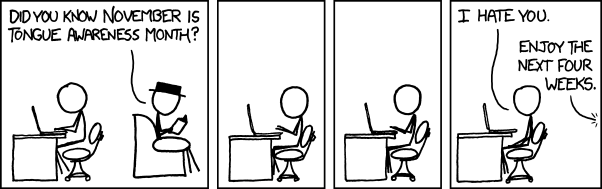
Apt cartoon by xkcd, about tongue awareness.
Saturday, April 23, 2011
Anger and OCD
OCD Reflections had a recent post about White Hot Anger that struck a chord with me, about how she usually keeps her frustration to herself, and if she is angry, it must be fully justifiable, and also gets angry at herself for getting angry. I was the girl who quickly learned that anger was a really bad idea in my family. When my father left he told me I had no reason to be angry, but he was the same person, just in a different context. My parents never fought. I can only remember one disagreement articulated, about whether or not a minor cut needs a bandage, or to fresh air.
This aversion to anger got entangled with my OCD, and when I felt anger, I immediately started analyzing it, trying to figure out if I was justified to feel angry, retracing the conversation, attempting to reconstruct every word. By the time I did this gauntlet of compulsing, the anger was even stronger. One of my feared consequences was that I wouldn't survive feeling angry, that it was dangerous. Another fear was that the anger would never dissipate, and I would be stuck with it forever, haunted by it. Ironically, my compulsions made this come true, by intensifying the feeling.
My ERP therapist told me anger wouldn't kill me, which of course sounded crazy and made me angry. My perfectionism latched onto being angry as "wrong" and I would berate myself for having angry feelings. My therapist told me that feelings just are, that they are just there, and not "justifiable" or "unjustifiable." We can control our actions in response to our anger, or how we view our anger, but if the feeling arises, the more we flee from it, the more it lingers, much like any of my other obsessions. Anger can be a sign that something needs to change, that we feel exploited, or taken advantage of, or hurt, and can give us the energy and motivation to make changes.
The more willing I am to just let the anger be there, as uncomfortable as it is, the less intense it gets. I also need to be willing to guess if I'm angry instead of knowing "for certain" that I am angry--I used to spend a lot of time and energy trying to establish if I was truly angry or not. Anger has set off my OCD in the past, as have just about any strong feelings, negative or positive. But anger was also one of the motivators for my seeking treatment for my OCD, anger at how OCD was eroding my left and affecting my relationships. I met someone who had severe OCD as a child, and if someone tried to interfere with her rituals, she was get extremely angry and lash out. She wasn't able to articulate her fears, or what was going on in her head, and was sent away to a residential school, and it was many years until she was diagnosed with OCD and got treatment, and an understanding that she could survive without her rituals.
How does anger interact with your OCD?
Friday, June 25, 2010
Vacation and OCD: It wants to come along. . .
This year though, although these same kinds of thoughts have occurred, I haven't latched onto them, and wrestled with them until I was a sweaty mess. I used to compulsively research vacations in order to try and get some kind of control, but I am learning that part of vacation is making it up as we go, and as daunting as my OCD finds anything spontaneous, I am making this an exposure, to have a good time dammit. . .OCD also came in the form of "am I enjoying this trip enough? Did I experience that right?" along with fear of not choosing to do the right activities at the right times, so again, big exposure time here, because the flashes of freedom, fun and joy I've had when I stay in the present moment are lighting the way.
Tuesday, April 27, 2010
Knitting Myself Together
I learned to knit shortly before I began treatment for my OCD, and I fell in love with the process of creating something with sticks and string. When I knit, I am more likely to stay in the present moment, anchored by the motion of my hands and the texture of the yarn. At first, I had to fight the perfectionist voice telling me I'd never learn, but in fact I did learn, especially since the woman who taught me to knit told me that there are no mistakes, only "design features." She taught me to recognize my knitting "mistakes" and once I could "read" my knitted work, I could figure out how to correct it. I think this is true with many things in life--if I flee from looking at what is going on, how can I change it?
Knitting helps me with my social anxiety. I joined a knitting group, and I find I can participate more easily in conversation while knitting, and we have a common topic to discuss, and knitters tend to be really cool people!
Knitting also gave me something to do when I went through a spike in my hair pulling,. I'd always found running my hands through my hair soothing, and pulling out the gray ones, and when my anxiety accelerated in anticipating seeing my father, I pulled to the point of making a bare spot on the top of my head. Knitting was soothing, and also kept my hands out of my hair.
I don't make anything that has to fit. I don't knit sweaters or complicated lace. I could knit plain garter stitch forever and probably be happy, as long as I have interesting yarn to play with. I knit scarves for ship workers through the Seamen's Church Institute, which is very gratifying, knowing my scarves help keep someone warm.
Any knitters out there?
Related Sites:
If you want to try knitting, a great source of information on knitting is found at the social network for knitters, Ravelry.
Trichotillomania Learning Center for information about hair pulling and skin picking
Knitting helps me with my social anxiety. I joined a knitting group, and I find I can participate more easily in conversation while knitting, and we have a common topic to discuss, and knitters tend to be really cool people!
Knitting also gave me something to do when I went through a spike in my hair pulling,. I'd always found running my hands through my hair soothing, and pulling out the gray ones, and when my anxiety accelerated in anticipating seeing my father, I pulled to the point of making a bare spot on the top of my head. Knitting was soothing, and also kept my hands out of my hair.
I don't make anything that has to fit. I don't knit sweaters or complicated lace. I could knit plain garter stitch forever and probably be happy, as long as I have interesting yarn to play with. I knit scarves for ship workers through the Seamen's Church Institute, which is very gratifying, knowing my scarves help keep someone warm.
Any knitters out there?
Related Sites:
If you want to try knitting, a great source of information on knitting is found at the social network for knitters, Ravelry.
Trichotillomania Learning Center for information about hair pulling and skin picking
Friday, April 23, 2010
Mindfulness and OCD: Full Catastrophe Living by Jon Kabat-Zinn
Full Catastrophe Living by Jon Kabat-Zinn
was one of the first books I read that helped me to observe what was going on in my mind, and not become the thoughts.
I was on vacation with my husband in the summer of 1999. I dreaded trips and the spike of anxiety that came with them.
Unfamiliar surroundings + free time + belief that I didn't have any right to enjoy anything + belief that if I did enjoy something, then something bad would happen=high anxiety. I came across Kabat-Zinn's book as we were checking out a local bookstore. Something about the title resonated with my sense of impending doom. I started reading that evening.
We went to visit old friends who lived on top of a mountain. As I sat in their living room, watching hummingbirds hovering at the feeder outside the picture window, my eyes glanced down at my arm, and a mole which I had fixated on the past suddenly became the total focus of my attention, and knocked my heart up into my throat. I excused myself and went into the bathroom, and examined the mole. I felt my knees sinking, a cloud of dread blocking out all peripheral vision, reducing my consciousness to the mole.
The observing part of myself saw how quickly the anxiety came, like an injection, and how much I hated it. Kabat-Zinn helped get me back in the room, back into a 3-D world. The present moment is all we have. If we exile it into trying to know the future(is this mole cancerous? Will my anxiety ever go away?), we are losing our lives. I went back into the living room to watch the hummingbirds. It wasn't like a conversion experience or magic, just a glimmer of being more than my anxiety and obsessions. It sucked having the wind knocked out of me by anxiety. I felt tentative, vulnerable, sad. I felt weak. And yet, my observing self was alive, and hanging on somehow.
I was on vacation with my husband in the summer of 1999. I dreaded trips and the spike of anxiety that came with them.
Unfamiliar surroundings + free time + belief that I didn't have any right to enjoy anything + belief that if I did enjoy something, then something bad would happen=high anxiety. I came across Kabat-Zinn's book as we were checking out a local bookstore. Something about the title resonated with my sense of impending doom. I started reading that evening.
We went to visit old friends who lived on top of a mountain. As I sat in their living room, watching hummingbirds hovering at the feeder outside the picture window, my eyes glanced down at my arm, and a mole which I had fixated on the past suddenly became the total focus of my attention, and knocked my heart up into my throat. I excused myself and went into the bathroom, and examined the mole. I felt my knees sinking, a cloud of dread blocking out all peripheral vision, reducing my consciousness to the mole.
The observing part of myself saw how quickly the anxiety came, like an injection, and how much I hated it. Kabat-Zinn helped get me back in the room, back into a 3-D world. The present moment is all we have. If we exile it into trying to know the future(is this mole cancerous? Will my anxiety ever go away?), we are losing our lives. I went back into the living room to watch the hummingbirds. It wasn't like a conversion experience or magic, just a glimmer of being more than my anxiety and obsessions. It sucked having the wind knocked out of me by anxiety. I felt tentative, vulnerable, sad. I felt weak. And yet, my observing self was alive, and hanging on somehow.
Wednesday, March 3, 2010
Singing from Myself
There was an article in the paper about research on music and the brain, and how trained musicians were better at picking out speech from background babbling. They could cut through the noise to the meaning. Several years ago, I read that singing uses a different part of the brain than the obsessing/compulsing part, and I started singing in the shower in hopes of getting a little peace and to keep moving through my day.
I sang a lot of verses of Kum-by-Yah, the only song I could really sing out, and discovered that it did free up some space in mind from the crowd of intrusive thoughts and compulsive figuring things out. I found a voice teacher, and after much indecision, decided to take lessons, even though I wasn't sure if it was the "right" choice(ie. existential questioning about whether I really wanted to sing, and how did I know for sure, and did I enjoy it enough etc.) Later I joined a choir. In the past, before my therapy with Molly, this was all unimagineable in the midst of my social anxiety, and the novelty of choosing to do something I wanted to do.
I feel good when I sing. It's not that the anxiety and obsessiveness disappears, but that I can find myself in the midst of it, and be present in the room, in the moment, be someone beyond my OCD. Like the singers in this research study, I can pick out what is meaningful when I'm singing.
I sang a lot of verses of Kum-by-Yah, the only song I could really sing out, and discovered that it did free up some space in mind from the crowd of intrusive thoughts and compulsive figuring things out. I found a voice teacher, and after much indecision, decided to take lessons, even though I wasn't sure if it was the "right" choice(ie. existential questioning about whether I really wanted to sing, and how did I know for sure, and did I enjoy it enough etc.) Later I joined a choir. In the past, before my therapy with Molly, this was all unimagineable in the midst of my social anxiety, and the novelty of choosing to do something I wanted to do.
I feel good when I sing. It's not that the anxiety and obsessiveness disappears, but that I can find myself in the midst of it, and be present in the room, in the moment, be someone beyond my OCD. Like the singers in this research study, I can pick out what is meaningful when I'm singing.
Saturday, February 20, 2010
Listening to Jazz and the Power of the Present Moment

Last night I went to a jazz concert with friends. I started listening to jazz about 4 or 5 years ago, and I am grateful to have found something that fills me with such delight! The musicians almost invariably are enjoying themselves, and listening to each other, responding to each other in the present moment, a musical conversation with many turns down unexplored roads.
When I am in the middle of OCD obsessions, I am not in the room, or in my life. I am slowly building my skill at staying present enough to actually respond to what is happening, rather than catapulting myself into the past or the future. OCD resents the present moment, and would prefer to launch into a barrage of worry about "Am I staying present enough? Am I doing this right? Did I enjoy that last solo completely?" The joy of jazz for me is that it's easier to let those thoughts be there, and still find pleasure in the music.
Sunday, February 14, 2010
Letting the Thoughts and Feelings Be There
I got to the grocery store this morning and started feeling overheated in my winter coat, and very tired, and running behind schedule, and felt a rising panic. I practiced letting the feelings and sensations be there without judging them.
I hate the whole concept, because I judge the feelings very harshly, and I want them gone. It's only because the escalation of panic due to my incessant judging is so painful that I even consider following my therapist's advice.
I'm fortunate that Leonard has worked with me in session to focus on sensations without judgement, asking me to describe to him the heat in my cheeks, or the tightness in my chest, or the pressure in my jaw, and letting them be there without getting into a wrestling match. Then he'll ask me if I can tolerate the feelings, as they are.
Tolerating is different than liking. It's often uncomfortable, unpleasant or painful, but without the interference of my OCD interpretations of "I'm going to die. I can't stand this. What if I am seriously ill? What if I lose it?" toleration is possible. It takes all the strength within me to admit this. But I've seen what happens when I battle the thoughts and feelings. I've seen it consume me, and intensify the sensations, and truly cause me to lose it, and this creates just enough willingness in me to consider there are alternatives.
Friday, February 5, 2010
Unhelpful Strategies for my OCD: Relaxation Exercises
When I was in graduate school, and had a blast of anxiety that the numbness in my hand was Guillain Barre Syndrome, and went to see a psychologist at the Health Center, she gave me a cassette tape of guided progressive muscle relaxation. Tense each muscle group and then let it go. Later, I had a therapist that wanted me to imagine a relaxing enjoyable scene and invoke it when I felt anxious. This didn't offer me much relief though.I do believe that the body and mind are intricately intertwined, and I know that I carry a lot of tightness in my muscles, and am hypervigilant about uncomfortable sensations, which seem to speed me into obsessive thoughts at quite a clip. But undoing the tension in my body doesn't undo the thoughts in my mind. I could get into a deeply relaxed state, and then a thought would pop up, and ruin it, and I'd try to wrestle the thought down, and keep checking whether I still had the thought, was it still bothering me? Was it still there?
I also tried weekly massage sessions for a couple years. My mind would run around like a twitchy squirrel while the massage therapist worked on my knotted muscles. I'd leave reeking of lavender and criticizing myself for not enjoying the massage enough, that I was defective for being unable to relax.
Thursday, January 14, 2010
OCD and Living in my Head

I tend to go awry on new projects. The OCD is opportunistic and latches onto anything new with leech-like vigor. My intention was to find an avatar for this blog and several hours later I was past the time I needed to leave my computer, looking for an image that "felt just right."
Perhaps you have had this experience of not feeling finished, even if you can't articulate exactly what finished would mean.
OCD is seductive and says, "Just search another minute, or 15 minutes, or until the top of the hour or until you've looked at every single link in a list. . ." and before you know it, you are oblivious to your life, and completely in your head.
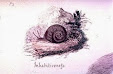
I did find an illustration. I still had misgivings, but just enough self-awareness to know that it would be good exposure for me to go with it in spite of this. It is an etching by George Cruikshank from a series he did of human capabilities, in this case ironically illustrated by a snail. Inhabitiveness resonated when thinking of the old habits I inhabit, like compulsive researching. My fingers are itching to do some major research of who this author was, and etymology of the word, but for this blog to be about Exposure Therapy, I am practicing just writing.
OCD steals the present moment. I had no real sense of what was going on around me while I searched for an image. I was firmly in my head. I'd like to move into the rest of my body. The snail at times also seems like my totem animal. I feel like I am moving very slowly in moving beyond OCD. But I am moving, and to acknowledge that is a big step.
Subscribe to:
Posts (Atom)