Showing posts with label obsessing about obsessing. Show all posts

Thursday, April 11, 2019

OCD A to Z: U is For Unique Fears


U was a hard one at first, but I remembered how many times I've encountered concern about having unique fears on the OCD Support Yahoo group, and in my own OCD support group, and in comments and emails from readers. OCD is as diverse as the people who suffer from it, with obsessions and compulsions that can be as unique as a fingerprint, but sharing the commonality of being human, and suffering from this disorder.
  • There is a despair that you are the only person who has a unique set of symptoms, and therefore maybe it's not really OCD, but something more dire.
  • There is fear that if no one else has these symptoms, no therapist will be able to help.
  • There is a visceral panic that the very bizarreness of your thoughts is a sign about you as a person, and your worth.
These fears are compounded by the lack of therapists trained in Exposure and Response Prevention Therapy, and who have sufficient experience treating OCD. For an inexperienced therapist, OCD symptoms may sound unique, but to someone who is familiar with OCD, they can see the underlying thread, the essence of the disorder underneath the permutations. This is not the same as finding a perfect therapist, and if you are like me and have perfectionist OCD, this can make it difficult to accept that all therapists are imperfect, even good ERP ones.

OCD is strangely unknown. Yes, there are whole reality TV shows devoted to it, but when faced with a patient in their office, it is all too easy for therapists to be distracted by the individual symptoms, trying to figure them out, trace their causes. This is what works in therapy for many other problems. I believe that recognizing OCD can be learned. My therapist didn't start out as an ERP therapist, but his OCD patients weren't getting better, and he wanted to learn more, and he educated himself, and now wants to go out and spread the word to his colleagues through continuing education and conferences.

It's like when someone mentions something and then you see it everywhere, but before then, you never noticed. Here is my prescription for therapists who want to learn more:

My prescription for someone suffering from a fear of having unique, untreatable symptoms would be much the same as for therapists, along with the knowledge that this is OCD's mode of operation to latch onto whatever is important to you, whatever your unique life experiences. For me, obsessing about obsessing is a struggle, so worrying that my OCD wasn't OCD, became one of my key themes, and I had to practice doing imaginal exposures, listening to scripts about how my OCD might really be something else, or untreatable, while going ahead with my treatment.

Monday, June 4, 2012

Finding Hope in the Midst of Anxiety and Obsessing: It IS Possible

Hope Mosaic by Exposure Woman

Awhile back, one of my readers asked if I would post some of my art.  This is an even bigger exposure than making a video about my OCD for my last post!  As I wrote in Your one wild and precious life, my love of art gives me strength for facing my OCD.  The joy I feel when making art is something that allowed me a glimmer of hope that my life could be my own, rather than in the thrall of OCD.

Hope means looking forward to something, and some suggest that it is related to hop, to leaping in expectation.

The first time I read an article by Jonathan Grayson about obsessing about obsessing, I felt a leap of hope that someone understood what I was experiencing, the angst that I would do something to trigger my obsessing, and trying to figure out if I really was obsessing.  Grayson believed that exposure therapy could work for obsessions of the mind.

Meeting my exposure therapist, Leonard, for the first time also made my heart leap with hope.  He was a worthy foe of my OCD.

None of these things meant I was certain I'd get better or that someone could help me or that I could do exposures and survive them.  OCD had been demanding I be certain for quite some time--certain I had OCD, certain I had the right therapist, certain I was doing my exposures correctly--and this eroded my hope in the guise of helping me.   If your OCD is anything like mine it may sound like this:

You don't have enough hope.  You'll never get better.  What are the signs of hope in your life?  Figure that out.  Do a search on the effects of hope on dealing with mental illness.   What is wrong with you? Why do you feel despair?  You'll never get better.  
Whoever you are, if you suffer with anxiety and the exhaustion of worries chasing each other, remember that there is hope.  It is possible to get better.  It is possible to claim your one wild and precious life.  You are not broken, irredeemable, beyond mending or repair or healing.  If you don't have hope, you can borrow some of mine.


H is for Hope

Monday, May 21, 2012

Living with Me and My OCD: An Interview for Claire's Documentary


ClaireJaneOCD on twitter is creating a documentary about the experience of having OCD, and invited me to contribute a video.  Claire and Jane are twins in the UK, who just completed running a marathon in order to bring awareness about OCD.  This is my first time recording myself!  And definitely an exposure to make it, but hopefully will be helpful to other people who struggle with OCD.

Saturday, March 31, 2012

Sensorimotor Obsessions: Hyperawareness of Body Sensations

princess pea final 001

I have felt an affinity to the Princess who can feel the pea under all the mattresses in her bed. When I read David J. Keuler's article, When Automatic Bodily Processes Become Conscious: How to Disengage from "Sensorimotor Obsessions", I recognized myself. Here is Keuler's list of examples of Sensorimotor Obsessions:

  • breathing [whether breathing is shallow or deep, or the focus is on some other sensation of breathing]
  • blinking [how often one blinks or the physical requirement to blink]
  • swallowing/salivation [how frequently one swallows, the amount of salivation produced, or the sensation of swallowing itself]
  • movement of the mouth and/or tongue during speech
  • pulse/heartbeat [awareness of pulse or heartbeat, particularly at night while trying to fall asleep]
  • eye contact [unlike social anxiety-based concerns, this form involves awareness of the eye contact itself or which eye one is looking at when staring into the eyes of another person]
  • visual distractions [e.g. paying attention to “floaters”, the particulate matter that is drifting within the eye that is most visible when staring at a blank wall or awareness of subtle movements of the eyes, such as saccadic eye movements]
  • awareness of specific body parts [e.g. perception of the side of one’s nose while trying to read or, as in the cases of a young boy and older man, a hyper-awareness of particular body parts such as their feet or fingers respectively]
My health anxiety is linked in part to assuming what I am aware of is dangerous. Floaters in my field of vision were particularly hard to deal with because I was afraid it was serious, and then when the doctor said it wasn't, I was worried I'd be aware of the bits of gray squiggles forever, and haunted by them, and I obsessed about obsessing. Bladder sensations took up a lot of my mental space from an early age.

Keuler proposes treatment consisting of:
  • Helping the sufferer understand that awareness of automatic body processes is not dangerous
  • Exposure to the sensation and prevention of responses such as distraction.
  • Body Scan and Mindfulness, and learning to observe sensations without judgement(Jon Kabat-Zinn has detailed instructions for doing a body scan. I did them everyday for many years, and it helped expand my focus.)
He suggests post-it notes with reminds of the sensation in strategic locations, practicing inviting the sensation in rather than fleeing from it, which ultimately leads to less sensitivity to the sensations and/or greater tolerance of them. Before you panic at the thought of purposely evoking sensations you'd rather banish forever, remember that in actuality you can't perfectly set up the world to never remind you of your breathing, your tongue or your bladder.

I know that bliss when a sensation recedes and the agony of something reminding me of it, but it's the jolt of encountering the feeling reinforces the anxiety, making me wish I could ratchet down my life even more so that I never get surprised. It was liberating to discover that I could purposely face the sensation, and not have to tiptoe around my life.


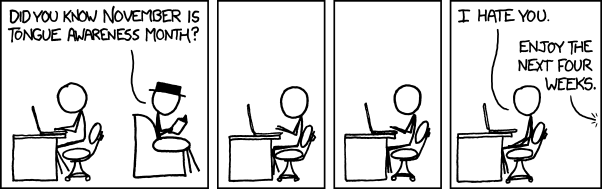
Apt cartoon by xkcd, about tongue awareness.

Tuesday, May 25, 2010

Do I have to go? Bladder fears and OCD.

bathroom light 35mm

I've observed that my ocd obsessions can recombine with each other, and persist over many years. At age 8 or 9, I became hypersensitive to any sensation of pressure in my bladder. I'd get up multiple times to make sure there was not a drop left in me, because I had the obsessive thought that I wouldn't be able to fall asleep if I didn't. When I went away to college, I had a room mate who was swigging cranberry juice in hopes of warding off a bladder infection. I'd never heard of bladder infections, and my ocd was immediately hooked. My fear of a full bladder melded with fear of getting a bladder infection.

On my 21st birthday, I had a sudden heavy ache in my pelvis. Stress makes my ocd worse, as does having a lot of free time, and this was a very lonely and stressful summer. I went to an urgent care center and the doctor treated me empirically for a bladder infection, ie. he figured that's what it was, and didn't do a urine test.

Right before my 27th birthday, my symptoms returned and I agonized about seeing a doctor, afraid I was weak, and wrong in my self-diagnosis. The nurse did a rapid test and said I had an infection. I felt a bit of relief, but then I got a headache, and feared it was from the antibiotic. I descended into health anxiety hell, into constant monitoring of how I felt, into fear of every sensation, every unknown, a dogged headache, and feeling dazed and overwhelmed when in the sun. I called the drug company hotline and they told me it wasn't the medication. I finally went back to the doctor, who diagnosed flu and gave me darvocet to help with the headache, but which only exacerbated my obsession about medication side effects. My infection symptoms went away, but my obsession with a bladder infection remained, and my fear of it spreading to my kidneys, of being condemned as negligent for not coming into the doctor sooner, and fear that I could bring on an infection by thinking about it.

On my 34th birthday, on vacation, I started worrying I had an infection. I went to the bathroom at a restaurant, and I felt a sensation of warmth, and panicked. I drank cranberry and water, with constant monitoring of my how my bladder felt which of course felt full. Later, I could look back and note that in a chilly air conditioned restaurant, chances are that the fluid in my bladder is going to feel warm. In the night, after getting up to drink water every 1/2 hr, I sat down with my journal and wrote about whether I really believed that I could cause an infection by thinking about it. I took a leap of faith and stopped drinking the water that night, and went back to bed. I was scared as I laid down, scared of the dizzy feeling of being on a precipice of anxiety, but I knew unless I took the risk of resting, rather than compulsively drinking fluid, I would be a captive.

OCD compulsions have an uncanny way of creating the very condition that you fear. Constantly checking my bladder made me hyperaware of every bit of pressure. Drinking constant fluids, in hopes of diluting any bacteria, created constant urgency to urinate. Trying to get rid of thoughts of getting a bladder infection made me focus on it even more.

Related:
OCD Squawking

Monday, May 17, 2010

Am I still anxious? Does this still bother me? And other querulous questions.


It's as if I am poking someone who is sleeping, and saying "Are you sleeping?" poke, poke, poke, and then they wake up. The mental ritual of checking on my anxiety level or sensations is one of the hardest to deal with. I'm sure that some of those reading this blog have had the experience of being consumed by anxiety about a particular obsession or topic and then getting up the next day and the anxiety is gone. I assumed that once anxiety set in, only sleep could fix it, and I would long for it to be the next day.

Even more frustrating is waking up calm, and then remembering my anxiety from the day before and having it all kick up again. My immediate response when remembering an old worry is "Damn, there it is again. Why can't I get it to go away?" It's like a staticky bit of plastic that you try to flick into the trash, and it just clings to your fingers. This is followed by having the urge to check if I am still anxious or if a certain symptom or thought still bothers me, and the more I check, the more entrenched it gets.

I would recognize anxieties that would probably fade the next day, like fear that I'd chosen the wrong dish off a menu, and I'd be frustrated by my inability to step away from it sooner armed with this knowledge. Knowledge alone is not a match for the anxiety created by OCD. My theory is that sleeping would give me a break from poking at the anxiety, waking it up, and increasing its noisy dominating behavior. It wasn't a magical cure.

My therapist has encouraged me to let my anxiety producing thoughts into my mental space, letting the noise happen, in fact practicing introducing the noise into my mind, which is an exposure. I usually feel snarly when he suggests this, but I also recognize that the vigilant checking to make sure the intrusive thoughts aren't there repeatedly reminds me of them. And every "Damn there it is again," highlights the thought, magnifies it, makes me exquisitely sensitive to even the threat of a particularly despised thought.

I know this sounds crazy. If you are desperate to avoid a scary thought, and you forget it for a few hours, the last thing you want to hear is the idea of purposely seeking it out, and disrupting that bit of peace. But the peace is fleeting and leads to long term anxiety--I have never been able to force a thought out and make it stay out for good. I have learned that it is possible to enjoy life even with those thoughts making noise.

Thursday, May 13, 2010

Gravity Legs

Gravity...
So here's what my ocd was up to on Tuesday:

OCD: What's that on your legs?
Me: Kind of looks like broken blood vessels.
OCD: There were some last week on one leg, but now they are on both. This must be serious. You need to know what they are.
Me: Maybe the marks have been there awhile and I didn't notice until I start wearing summer clothes. It doesn't hurt or itch.
OCD: It could be connected to your low iron count. It could be really bad. What if you don't go to the doctor and then it turns out that you missed a major sign of a serious illness? Look it up.
Me: When I look things up, I deteriorate quickly. I find something scary, and then keep searching and searching.
OCD: BUT. YOU. NEED. TO. KNOW. NOW.
Me: I could go to see my doctor.
OCD: But in the meantime, look things up. You can't wait. You will implode with anxiety, and you'll start obsessing about this constantly.
Me: This uncertainty is very uncomfortable. I would like it to go away. Given a choice between websearching and going to the doctor, in spite of potential humiliation of it being nothing, I'd rather see the doctor. I'll call.
************************
OCD: Oh, man. The receptionist offered you an appointment at 4:00--it must be serious.
Me: I won't know until I get there.
OCD: What if it is really nothing? The receptionist asked if it hurt and you said no. You led her astray by calling in the first place. You are just obsessing again, and deficient as a human being. This is just like your past--seeing the doctor for reassurance.
Me: Yes, it might be nothing. Part of me really suspects it's just the effects of age. You aren't very flexible OCD--you are demanding I know ahead of time what is wrong or not wrong with my skin. That's not humanly possible.
OCD: You suck. You'll never get this right.
Me: Yeah, you could be correct, but there is no universal law that if you guess wrong before seeing the doctor, you qualify as a failure.
********************************
At the doctor's office:
Dr: Let's see what's going on with your legs. (Leans in to look.)
Hmmm. I certainly didn't think, "Oh, my goodness. What happened to your legs??" (Gets down on floor to take a closer look.) I don't think it's clinically significant. Kind of looks like broken blood vessels. Maybe it's just gravity. I can do some blood work, but I would be very surprised if something bad was going on.
********************
So here I am. I survived this visit. The biggest difference now is that I could joke about my "Gravity Legs Syndrome," with my husband. I had my blood taken today and now I wait for the results. Part of what got to me so quickly was the fear of obsessing. What if I start obsessing about this? What if the fear never dissipates? This combined with the old crap about being a failure and worthless makes for a powerful cocktail of anxiety. I felt fatigued by my OCD hypervision, but relieved that I didn't feel my value as a person was on the line when visiting the doctor, in spite watching her crawl around on the floor trying to see what I can see.

Monday, February 8, 2010

OCD Toolbox: Freedom from Obsessive Compulsive Disorder by Jonathan Grayson

This book, Freedom From Obsessive Compulsive Disorder: A Personalized Recovery Program for Living with Uncertainty by Jonathan Grayson, was very important in moving me to get help for my OCD. I'd spent a lot of time reading about OCD, but assumed that because much of what I dealt with took place inside my head, rather than physical rituals, Exposure and Response Prevention Therapy wasn't really for me.

Grayson went right to the heart of this by identifying mental rituals, and describing how to write scripts that expose you to your "Pure O" fears, and learn to habituate to them, and live your life. He gets the "obsessing about obsessing" quicksand of the OCD mind. And even more importantly, he introduces the concept of learning to live with uncertainty. I recognized myself in his descriptions right away, a compelling desire to have absolute certainty that a feared consequence will not happen.

OCD makes a lot of demands for omniscient knowing, for complete understanding, for predicting the future and insisting that questions be answered that no human gets answered. It sucks to accept the reality of our tenuous existence, but Grayson points out that we tolerate uncertainty in many aspects of our lives, if it is not one of our OCD triggers. He has an example of how someone who has no fear of driving takes the risk of crashing their car just go see a movie. Last week, I thought of this example when I heard that some people I know from choir were in the hospital because they had a car accident on the way to see a movie.

We take risks everyday, but often we don't think about it, because life is in itself risky, and if we wish to experience the joys that life offers, we have to keep moving. On a bad OCD day, I really hate this revelation, because the OCD insists that I can have certainty of safety if I just ritualize, and it's hard to let go of the fantasy. But the fantasy is at the expense of having a life, a kind of living death.

Another Good Book:
Rewind, Replay, Repeat: A Memoir of Obsessive Compulsive Disorder

Friday, February 5, 2010

Unhelpful Strategies for my OCD: Relaxation Exercises

When I was in graduate school, and had a blast of anxiety that the numbness in my hand was Guillain Barre Syndrome, and went to see a psychologist at the Health Center, she gave me a cassette tape of guided progressive muscle relaxation. Tense each muscle group and then let it go. Later, I had a therapist that wanted me to imagine a relaxing enjoyable scene and invoke it when I felt anxious. This didn't offer me much relief though.

I do believe that the body and mind are intricately intertwined, and I know that I carry a lot of tightness in my muscles, and am hypervigilant about uncomfortable sensations, which seem to speed me into obsessive thoughts at quite a clip. But undoing the tension in my body doesn't undo the thoughts in my mind. I could get into a deeply relaxed state, and then a thought would pop up, and ruin it, and I'd try to wrestle the thought down, and keep checking whether I still had the thought, was it still bothering me? Was it still there?

I also tried weekly massage sessions for a couple years. My mind would run around like a twitchy squirrel while the massage therapist worked on my knotted muscles. I'd leave reeking of lavender and criticizing myself for not enjoying the massage enough, that I was defective for being unable to relax.

Monday, January 25, 2010

OCD Toolbox: Listening to Scripts/Imaginal Exposure

My husband had this habit, when records were still current, to play one side over and over, the arm continually lifting up and going back to the beginning. This drove me crazy, but it's the same principle that helped me to deal with my indecision. Jon Grayson discusses this in his book, and once I started writing and recording and listening to scripts as both exposures and support for doing exposures, I was able to give the healthy part of myself more airtime. OCD usually has a monopoly on all channels, and has worn deep paths into my brain, but scripts gave me some alternatives.

Traditionally, tapes were made on the itty bitty cassettes in answering machines that can loop over and over. I used QuickVoice recording software, which is very inexpensive, and fairly straightforward to use, which enabled me to record my scripts sitting at my computer with no additional microphone or device needed.

I then listened to the script continuously on my iPod Nano. I have about 50 scripts that I wrote and recorded. In the case of decision making, when I went grocery shopping, I would listen to a script I wrote about it never being possible to make a "perfect" decision and that OCD will change the criteria of "perfect" the minute I start to reach for an item, and that my life was waiting.

The key was finding what gave me the most unease about an OCD fear, and directly addressing that in the script, putting it out there, rather than running from it. Yeah, I might choose the "wrong" item and feel my face go hot, and a panicky ache in my chest. I might really screw up, and be haunted by regret about my poor decisions and never have any peace from the obsessing about obsessing.

For about a year, I took the shopping script with me almost everywhere I bought things, and listening to it continuously, logging many hours, and gradually, in combination with flipping a coin when I really felt stuck, I freed up a lot of time in my life instead of circling the aisles of the grocery store, looking at every item, reading every label, picking stuff up and putting it down, over and over.

Related Posts:
OCD Toolbox: Flipping a Coin

Thursday, January 21, 2010

OCD Flashback #1

Writing my post yesterday sent me back to when I was 13 or 14. I'd go to the mall, by myself, and circle the food court trying to decide what to eat for lunch. I had a big heavy winter coat on, mostly likely puffy. I'd keep circling, reading every menu, more than once. Being indoors with the dry heat blasting, sweat would start to roll down my sides and into my waistband. I'm sad thinking of this poor girl and how exhausted she'd be by the time she finally ordered something for lunch. The food court was like a spot for OCD galactic meltdown. Not only did I need to choose where to get my lunch, but then which menu items.

In my 20's and 30's, if I had a day off, I'd become ravenous putting off lunch because I wasn't certain which task was "best" to do at any particular time, and if I did stop to eat, then I would have to decide what to eat, whether to eat at home or go out, and if I went out, I had a gauntlet of OCD questions to deal with--which would be the right place to eat? How would I know it was the right place? What did I have yesterday? Will I repeat myself?" All the while, hungry, not thinking clearly, sore footed, and generally frustrated with myself. A bone weary tiredness and a gigantic energy suck.

I loved places where I found something I liked, and could get it every time and it always tasted the same. This would be like a short cut to heaven! But life being what it is, nothing is ever completely consistent, and I am not psychic and cannot predict if the cook is having a bad day, and there is no Guidebook to Exactly What I Should Be Ordering.

I felt at war with myself. Part of me would just be "Order something already dammit. I'm hungry. I have other things to do." And the OCD would be going, "You will feel dread, doom, and not be able to focus on anything else if you pick something wrong, and it will suck up all the rest of your free time trying to make the dread feelings go away." Another sneaky slide into "obsessing about obsessing."

My ERP therapist used to work in a town with an incredible independent donut shop, which I would drive by on my way home, and I would stop and always get two donuts, even if I really was only hungry for one, because if one of them was disappointing, I had a back-up donut. The thought of boxing myself in with just one choice was panic inducing. I. can. not. make. a. mistake.ever. OCD will erode the most basic pleasures of life, including eating.

Related Post:
OCD Flashback #2

Wednesday, January 20, 2010

Yay for Dealing with Mediocrity

I had really mediocre bibimbap for lunch today at some express place I'd never been to, and what a relief to simply experience that it was like a salad bar selection of tired veggies, with spicy ketchup rather than Korean spicy red pepper paste, and then move on with my day.

In the past some of my most dogged ocd thoughts eroded my ability to enjoy eating out. I approached a menu like a test I had to study and answer perfectly, so there was a lot of pressure on making the "right" choices, because if I didn't, and the food wasn't good, then that meant I was an absolute failure, and I would try to "undo" that by going over my choice, and how I went wrong, and how to make sure I didn't do it again.

Then the obsessing about obsessing would start:
"Will I keep obsessing about this all evening?"
"Why do I do this? What is wrong with me?"

I once went out with a friend who picked up her menu, saw the first special, said "oh, that sounds good" and ordered it. That was alien behavior for me. I would've broken out in a cold sweat, assuming I should've examined each menu item closely and weighed my options.

OCD can be incredibly exhausting, especially when the observing part of myself could see that there was no real criteria for what the exact right choice was, and no way of predicting with complete certainty whether I would like what I ordered, and that judging myself defective in some way if I received mediocre food was disheartening, not to mention the cascade of "Am I enjoying this enough?" when I actually got a dish I liked. That is an existential question that cannot be answered.

So yay for today and my bad bibimbap! And surviving it. And making sure I don't go back to that place, which is what I suspect someone without ocd would do.

Related Posts:
OCD Toolbox: Listening to Scripts
OCD Toolbox: Flipping a Coin