It's been a hard month, and when I thought of what to do for Y, the phrase "Yet Again" came into my head. There's a jolt of surprise every time anxiety intrudes into my life, and a heart sinking disappointment. I have been learning to expect the anxiety, with less of a "yet again" and more of a "oh, it's you again." My therapist likes to tell me that I've had years practicing the old OCD stuff, and to expect it to come back. This isn't the same as being doomed, and that's the hard thread to hold onto when I'm having a hard time. If I expect the OCD to be there, and don't give into the "Oh, no, it's back. How can this be?" compulsion of figuring out, it's less likely to get worked into a big flare up.
The last month started with my husband being away for a week, which I find stressful, and stress makes my OCD worse, and since I've been doing so much better in the past 6 months, I was taken by surprise at all the old crap. My mother had her heart surgery, got released and then had to go back the next week for fluid under her lung.
Then, last week, I absentmindedly scratched at an itch on my ear, and it started to bleed, in the area of the spot where my squamous cell skin cancer was 5 or 6 years ago. I spent some time trying to see it in the mirror, actually two mirrors, and a flashlight, because it's part of my ear that's really hard to get a look at. I did remember that this is one of my compulsions, and the more I look at it, the more anxious I get. I haven't looked anything up on the internet. After a day of free-falling anxiety, I called my dermatologist. Her first available appointment was October 24th, but then the receptionist asked what I was coming in for and she said, "Hmmm. That sounds like something to come in sooner for." In the irony of OCD, I couldn't decide if this made feel better or worse!
Part of OCD is perfectionistic, and a fear of guessing wrong, and being humiliated at the doctor's office if I went for "nothing," so that part of me was relieved. Part of my OCD is health anxiety, and that part of me was like "WTF"?? So I'm seeing the dermatologist on Wednesday. Next, I called my therapist, and made an appointment for Thursday. He told me that it's unlikely I could diagnose a cancer by touch or by getting a look at it. . .and to go on with living my life, so that I don't lose that time, and also that the thoughts and anxiety will pop into my head, and that's normal, and if I don't do my compulsions, I'm less likely to relapse with my OCD this week. I could have a recurrence of cancer, or I could have a pimple, or sharp fingernails. As much as my OCD insists I can diagnose it, I can't, especially not by repeated checking.
Then I had coffee with my best friend yesterday. She's going through the possibility of a divorce, and first week at a new job, and all the old critical voices of her abusive childhood blaring full blast. She doesn't have OCD, but she understands the nature of insistent beliefs from the past, on high volume. (And got even more insight to the irrational fears of OCD, when she was offered the new job and suddenly feared she'd fail the drug test, even though she doesn't take drugs.) So she talked about her sadness with her marriage, and I talked about all the old health anxiety and perfectionistic voices saying "what's wrong with you? why did you scratch at your ear? why do you notice the smallest thing? or maybe you should've noticed it long ago? you are a bad person, you should know what's wrong", and it was a relief that she got it.
(Edited to add: biopsy was negative.)
Revisiting OCD A to Z from 2011.
Showing posts with label Health Anxiety. Show all posts
Tuesday, July 2, 2019
Sunday, March 31, 2019
OCD A to Z: M is For Medication
I knew I wanted to write about medication as my M word, but I felt anxious about it. My path to taking medication was long and convoluted. I'm up to Part 7.5 of my medication story, as you'll see from the list of posts below. In Part 7.5, I had been off my SSRI antidepressant(pitifully low dose for OCD) for several months, and increasingly trapped in my anxiety about my body.
My incessant seeking of answers about my symptoms led to more medical tests, including a biopsy and a freak accident, after which I could barely sit or walk, and all manner of bandaging as the wounds slowly healed. I've never experienced pain like that before. Getting in and out of the car was an ordeal. Yet in the middle of this crisis, I realized I needed real help, and I found a therapist on the International OCD Foundation list, who specialized in Exposure Therapy, and made an appointment, just a week after my injury. I drove 1.5 hrs through traffic, in raw pain, and limped into the therapist's office. I was trying to sit on the couch and talk about my symptoms of OCD, while feeling like a freak.
This Exposure therapist referred me to another therapist in the practice, Leonard, who helped me change my life. I had gone back on my tiny dose of the SSRI after finding out my sister-in-law had had a heart attack at age 49, and the health anxiety was more overwhelming than my fear of medication. Leonard advised me that OCD often responds to larger doses, and with my doctor's approval, I slowly ramped up my dose of the course of a couple of months to the maximum. Leonard didn't patronize me. He didn't throw meds at me. He helped me to see that in order to do my exposures, and have some breathing room from the OCD, that a high dose could aid that. I'm still on that high dose, and in the process of slowing down my ERP therapy, as I've made tremendous progress. In the past my OCD would be agitating to get me off meds right now, because of needing to know right now if there are long term effects. I still get those thoughts, but if I go off the meds, it will be on my terms not the OCD's, and for now, the benefit of reclaiming my life is enough.
[Revisiting OCD A-Z from 2011]
Part 1: OCD and Medication Decisions
Part 2: Starting Medication while Struggling
Part 3: The Limits of Research in Medication Decisions
Part 4: My First Prescription for SSRI's
Part 5: Feeling it in the Jaw: Side Effects of Medication
Part 6: Being on Medication & OCD Weeping
Part 7: Wanting to Get off my Medication
Part 7.5: Built on Sinking Sand: OCD and Health Anxiety
Sunday, November 4, 2018
OCD A to Z: E is For Exposure and Response Prevention Therapy(ERP)
When I first realized I had OCD, about 7 or 8 years ago, I joined the International OCD Foundation and started receiving their newsletter. As much as I learned from the excellent articles, I assumed that Exposure and Response Prevention Therapy(ERP) wouldn't work for mental obsessions, things happening in my head. Thoughts seem like the substance of our minds, unmovable. Another E word that came to mind was "endless," as a way to describe the thoughts that hang on like thistles on your socks after a hike.
But ERP does work as a treatment for mental obsessions, Pure O, intrusive thoughts. I am so much better than I was before I started ERP 4 years ago. Yes, at first it seemed like trying to see through muddy water, and having an experienced Exposure therapist helped me get far enough away to see the patterns and processes of the OCD.
In a nutshell, ERP is exposing yourself to a thought you don't want to have, or situations that evoke that thought, and then preventing yourself from responding with compulsions in order to make your anxiety go away. So if I have the thought that the ache in my side is appendicitis, which strikes fear into my heart, because I need to know for sure, and right now, an exposure could be saying "Yes, I may have appendicitis. I don't know for sure," and response prevention could be staying off google, not researching the symptoms, or calling my doctor, or going to the emergency room, or poking at my side to see if it still aches. And the ultimate result will be less sensitivity to that thought, an ability to let it float in and out, and continue on with my life.
I encourage anyone who suffers from mental obsessions to seek out an ERP therapist. Check the IOCDF's list of therapists, and also their list of OCD support groups. And read Jonathan Grayson's Freedom from OCD. He published some articles in the IOCDF newsletter about obsessing about obsessing which finally led me to seek help for my OCD.
[Revistiing OCD A-Z from 2011]
Related:
History of Exposure Therapy
Exposure Scripts for Pure O and Health Anxiety
Tuesday, October 30, 2018
OCD A to Z: B is for Body Fears
My awareness of my body as something to be feared started at age 8 or 9, and as symptoms started cascades of anxiety, I grew to believe that my body was against me, betraying me. I once made a list when I was 19 or 20 of all the different body fears I'd had experienced: swollen lymph nodes, strange moles, pounding in my stomach and on and on. I filled a long sheet of looseleaf, both sides. I would get very angry at my body, imagining it was willfully sabotaging me, generating symptoms. About 10 years ago, I had symptoms I didn't understand, and the fury I felt at my body was intensifying, when I had a sudden thought: My body doesn't know any more than what's going on than my mind does. My body isn't plotting on how to get me anxious. OCD is generating the anxiety based on what I feel in my body, but adding a whole layer of interpretation, quick plunges into fear of serious illness, and increasing my focus on the symptoms.
[Revisiting OCD A-Z from 2011]
Tuesday, September 20, 2016
Fear of Noticing Floaters in the Eye: Update
One of the posts that gets a lot of response, even though it is from 2010, is Floaters in the Eye and OCD Vision. The post resonates with people who fear that the floaters will impede all enjoyment of vision. Part of my fear at first, in 1988, was that something was seriously wrong, but then after seeing an ophthalmologist, it became a fear of always noticing the floaters and having my life ruined by that, and yet now I don't notice them most of the time.
I went to a museum this summer with a very bright white room, and it made me really notice my floaters. It was not pleasant, and I wanted to leave, but it didn't dog me after that. In the past, I would have kept trying to see if the the floaters were still there, ever increasing my brain's vigilance and anxiety. Because of all the ERP therapy in the past, I was able to let it go once I left the white room. Do I want to go back to that museum room? No, not really. Do I find it annoying that they advertised how fabulous the art looked in that room ~ yes!! But it didn't ruin my experience of the day, and that is real progress for me.
If you have been evaluated by an ophthalmologist, then I would next look to find an Exposure and Response Prevention therapist or check out the International OCD Foundation or read Jonathan Grayson's Freedom from OCD, to work on the obsessing about the floaters never going away. You can work with an ERP therapist to find the most feared consequence of seeing the floaters in your eyes, and work on an exposure that deals with that, perhaps a script you listen to, or moving on with daily activities instead of stopping to focus on the floaters, and learning to habituate to the anxiety so it dissipates.
I actually stopped noticing the floaters most of the time even before I went for treatment for other aspects of my health anxiety OCD. If you contemplate your experience, you may remember symptoms that receded, even though at the time it seemed like they never would. Sometimes it was a rotating worry from one thing to the next ~ ERP helps you get off the Merry-Go-Round. Does hearing about other people's health issues still make me anxious? Yes. I had a talk with someone last week which turned into her describing her retinal detachment, and I could feel an upsurge of anxiety, but again, I could let it go because I will never have 100% reassurance that nothing bad will happen, and yet I can still live my life.
Thursday, December 18, 2014
The Mindfulness Workbook for OCD: Just Right OCD
I was glad to see a chapter on this form of obsession of doing things "just right, " also known as symmetry OCD, organizational OCD, and perfectionism OCD. The authors get the fact that the opposite of "just right" feeling is "feeling dead wrong," which has emotional intensity.
The one compulsion that resonated the most with me was:
- Checking to see see if things appear as you feel they should(for example, reviewing the placement of two pillows on a bed to make sure they are in the perfect position.)
When my health anxiety would be active, I would check whatever symptom I had against the opposite side of the body. This summer I had a feeling of a something stuck in my throat, and my urge was to keep checking to see if my tonsils were parallel, and then feeling ashamed that I looked in the mirror, and berating myself for my vigilance.
An Acceptance tool for Just Right OCD is allowing the "off" feeling to be there, noticing the body sensations, and carrying it with you "on your way to doing something greater than your compulsive fixing."
An Assessment tool for Just Right OCD is dealing with all or nothing thinking. When I used to sew for Home Ec class, I would become so fixated on any small asymmetry of top stitching, and therefore the whole garment was "ruined," even though other people would have a different frame of reference, and not even notice the stitches, but rather overall shape of the garment. Ironically, I won an award for excellence in Home Economics in 9th grade, even as I was convinced any flaw meant I was incompetent.
Taking Action for Just Right OCD includes recognizing that focusing on perfection can mean a tiny trigger can feel as disturbing as something more obviously huge, so setting up a hierarchy of exposures can seem impossible.
It's important to get in there and take any opportunity to let things feel "off" rather than trying to fix it. Trying to decide if I had a hierarchy of exposures "just right" could take up all my time and it helped that my ERP therapist understood this and encouraged me to practice tolerating the thought that I might do my exposures wrong.
Sunday, May 11, 2014
Dealing with Health OCD as a Teenager
I received a poem written by a 16 year old girl who suffers from OCD, and she gave me permission to write about it on my blog. I feel kinship with her, since I was in the midst of health anxiety OCD at her age. I didn't have the internet to look up symptoms, but I went to bookstores and libraries and read medical reference books. I am including a few excerpts from Eliza's poem:
OCD
In a crowd, it seems impossible to feel so alone . . .I tell my friend I have a sharp headache,And I wonder if she knows that the second class lets outI will immediately look up symptomsAnd pick the worst diseaseAnd that I will convince myself that I haveA brain tumor
***
It’s this stupid disease,That makes me obsess over a single worry,It’s this stupid disease,That makes me think I have a million others,It’s this stupid disease,That makes me hate myselfBut I continue, and no matter how hard it can beI get through itAnd because the worry and fear overcomes me,It just makes it all the more welcomingWhen happinessKnocks the wind out of me
Health Anxiety OCD is indeed the "stupid disease/that makes me think I have a million others." I hated myself at 16, hated how quickly and intensely I would worry about pains and spots on my skin and symptoms of any kind. I believed this was a defect in myself, that I couldn't control the worry.
I had moments "When happiness/knocks the wind out of me" and these gave me a glimpse of hope that I could feel something besides fear.
I had never heard the phrase "Obsessive Compulsive Disorder" or the acronym "OCD." I knew I had anxiety, but that was it. When I was 19 or 20, my mother was taking classes to become a counselor, and I picked up her DSM, a manual of diagnoses for mental illness. I don't remember seeing "OCD" but "Generalized Anxiety Disorder" jumped out at me for describing much of what I experienced. It was a relief that someone could describe this fear.
The missing component was treatment, and it took about 15 more years until I was diagnosed with OCD and found an Exposure and Response Prevention Therapist. There was a strong part of me that hung on, in spite of the fear, and I honor that part of myself and that of Eliza. You are stronger than you know.
Monday, February 3, 2014
Avoidance is not Benign in OCD or for the Body
What a metaphor for mindfulness, facing fears, doing exposure therapy for OCD!
Avoidance can bring on the very thing we fear: anxiety, pain, suffering.
Of course, frozen shoulder is somewhat of a mystery, as to how it arises in the first place. Uncertainty stirs my OCD.
But I am proud of myself for choosing to do something, one step at a time, rather than continuing to wait until the "perfect " time to call and the perfect kind of professional(family doc, physiatrist, physical therapist, massage therapist, chiropractor).
What do you avoid? What step can you take toward it?
Tuesday, January 21, 2014
One Word for the Year in Dealing with my OCD: Practice
I assume I suck at practice. Actually, I have amazing practice skills ~ practicing old rituals and patterns. I am going to a Mindfulness Meditation group, using the book Mindfulness: A Practical Guide to Finding Peace in a Frantic World by Mark Williams and Danny Penman. The defining word is "practice." Practicing being present. Practicing being with my body sensations and all the attendant thoughts.
It's been a hard few months, with medical tests and uncertainty, with one problem receding and another advancing, and all the old health anxiety stuff surging up. I knew I needed to do something to help take care of myself.
Check out the free mindfulness meditations on the Mindfulness site.
What would be your one word for the year, in dealing with your OCD? A word that inspires you to make progress.
Saturday, September 21, 2013
Doctors Can be Anxious Too
Doctors can be anxious too. I have assumed that I am always the anxious one, and most other people are calm. A month ago I went to see my family doctor about some body pain, and she gave me some medicine and told me to call her the next week to check in. When I did, and I wasn't 100% better, she said to make a specialist appointment just in case it still wasn't gone the next week. When I checked in again, and told her that my specialist appointment was October 21, she freaked out and said that was completely unacceptable, and I needed to be seen in the next 2 weeks. This in turn ratcheted up my anxiety! She also ordered a test for an ailment that would manifest pain in a different location, "just in case I had an atypical presentation."
My husband said, "Your doctor is anxious. I don't know if that is good for you." What we decided to do was have him do a search for treatment guidelines, rather than have me search, which is my primary compulsion with health anxiety. I felt blessed to have someone who would help me get more information, but who would stop long before I would ever feel "done" if I was searching myself.
I got an earlier appointment with the specialist, who said the medicine hadn't had enough time to work, and that we could set aside the test for the unlikely ailment. She did schedule a different test for October, but it was one my husband had found as the next step in the diagnosis process.
It's been a long week, with a dental appointment and a gynecology annual exam. Preventive healthcare is important, but my OCD gets all stirred up. Not to mention that I still don't feel good. The challenge is to keep doing things important to me, even if I don't feel 100% or know what's wrong with 100% certainty. Maybe my family doctor is right, and I have something unusual going on. Maybe it's just that I live in a malpractice prone part of the country. Maybe she lost someone to a disease and she never wants to lose someone again.
Sunday, August 25, 2013
OC87: A Movie About Courage and Living Your Life in the Midst of OCD
My husband was away, and I was feeling anxious. I've come a long way since the time I walked 7 miles around a lake in order to ward off the anxiety of being alone for a week, but I'd been having physical aches and pains in the weeks leading up to his leaving, and my OCD was stirring.
Feeling achy and anxious, I started searching for movies on Netflix. This was my way of avoiding searching for the meaning of my symptoms, but still, compulsive and exhausting. Working my way through the alphabet and the numbers, using the arrow keys to navigate to one letter at a time.
Then OC87: The Obessive Compulsive Major Depression Bipolar Aspberger's Movie came up. I remembered hearing about it when it came out a couple years ago, but I hadn't seen it. It was already midnight, but I started watching.
Bud Clayman majored in film in college, but thoughts that scared him, and depression infiltrated his life. OC87 refers to 1987 when he built his life around attempting to control the world around him, and the thoughts within him.
I was moved by Bud Clayman's persistence in making this film about his life now, after 30 years of OCD, depression and Asperger's, which involved dealing with people, dealing with his intrusive thoughts, indecision, anger and grief. I particularly liked the scene he wrote where he played both "Good Buddy" and "Bad Buddy" in a riff on a scene from Lost in Space. Part of this is in the trailer for the movie, the Bad Buddy telling the Good Buddy that he isn't capable of living without him, but Bud Clayman is capable of living his dream, even with the spectre of OC87, in the midst of the imperfections.
What this film reminded me was that to spend the week trying to figure out if my symptoms were a physical problem, or whether it was OCD, and freezing myself into a block of worry was a manifestation of my illness, and not what I want in my life.
In one scene, Bud asks a woman what films she likes, and she asks him the same question, and his answer is that Ordinary People is the best movie ever made. He describes how OC87 evolved out of a desire to describe how therapy had helped him, how it was a safe place, and how Ordinary People resonated with him, in its depiction of therapy.
Ordinary People is one of my favorite films, and I hadn't expected it to come up in Bud Clayman's film. I saw it when I was 12 or 13, several times, mesmerized. Netflix had it, and I watched it next. I'll write more about that.
Have you seen OC87?
Wednesday, August 14, 2013
OCD is in the Realm of Human Experience: The Painfulness of Uncertainty
Recently, a dear friend of mine had a call-back at her annual mammogram screening. We were having lunch and she told me how anxious she was. The appointment was the next day, and her mind was spiraling into "what ifs." She hadn't been sleeping.
I shared my experience with OCD, and some of what my exposure therapist had taught me, about the painfulness of uncertainty for humans, about how the present moment is the only functional moment, and that if something was wrong, she would deal with it when it happened.
I told her the story a friend had told me about a woman who had breast cancer, and then during a big storm a tree had fallen on her and killed her.
Then I felt bad for telling that story. It's not very reassuring. But it does get at the conundrum of being human, the inability to tell the future, the uncertainty even within the narrative of having breast cancer, where something else entirely can take you out. And my friend understood this. She knew I didn't want anything to happen to her, but that I did want her to be able to live her life.
I had a call-back after a mammogram several years ago, and the anxiety sucked. The more I was able to bring myself back to the moment, the more I was able to cope. Uncertainty is painful for humans, and the desire to race ahead and resolve things is strong.
There are times when what I am obsessing about coincides with fears of people around me, and they will reassure me that I "should" be worried, that it only makes sense. But worry isn't protective, and can erode the very life we love and are afraid of losing.
My friend was fortunate to be at a mammogram center where the radiologist reads it while you wait, and it was fine. This is compassionate care, mitigating what uncertainty can be mitigated.
Sunday, March 17, 2013
Dealing with OCD Health Anxiety and Preventive Screenings
I had a week in January with my annual screening mammogram, followed by my diagnostic colonoscopy for chronic anemia. I am proud of myself for getting through it all in spite of anxiety.
The mammogram center had moved to a new office and actually had a radiologist there to read the results while I waited, and the results were normal. My mind did its usual "what ifs" but I did feel a flash of relief.
The colonoscopy prep was not how I would like to spend a day, but it also wasn't awful, and it is encouraging that I can deal with something uncomfortable. There was a small benign polyp but not the cause of my anemia. I am in that borderland of being old enough that the gastroenterologist wanted to "make sure" even as he reassured me that nothing was probably wrong at the initial consult in November.
Medical screening and testing stirs up my health anxiety, and I am learning to accept that, and keep going. I did not do any web research. I did see my therapist when my anxiety was high in September, as I wrote about in a previous post. I am learning to expect the surge in anxiety and not launch int ruminating about why it is back, why the OCD anxiety shows up. This defuses my panic, and my "oh no!" response.
Thursday, December 13, 2012
Fear of Being a Bad Patient: Health Anxiety and Self-Worth
Problem for me is I also have social anxiety. Dealing with doctors is just as anxiety provoking as worrying about illness. My symptoms and test results seem just worrying enough to warrant monitoring the situation but I'm constantly worried the doctor will think I'm just being a hypochondriac.I've been thinking about this comment by MinM on my post Hypochondria and Health Anxiety OCD. The social anxiety of dealing with doctors complicates my health anxiety, as well as cultural stereotypes of women as oversensitive, and my perfectionism which demands I pre-diagnose myself and get it right before I even go to the doctor.
I actually looked through some books on hypocondria, but they all focused on worrying about something that has been ruled out. Which isn't the case for me. I'm working on establishing a format of when to call a doctor, which symptoms or tests should be followed up on and which need not. I'm finding this helps me to let it all go and enjoy things more, particularly when I am having low symptom period. I've got a ways to go, though. :)
I spent many years at my old job listening to medical residents do their rounds, and anything to do with the mind and emotions and human complications was a struggle for them in the midst of all the technical, diagnostic work they were doing. There was a staff psychologist who would sit in at times, and I was glad to have her there providing some perspective. Also, some residents were much more able to deal with anxious patients than others.
OCD is still an enigma to many people, professional or not, and health fears are often labeled hypochondria, even though health anxiety OCD has a significant component of dealing with uncertainty and rituals to try and undo the fear, such as repeated calls to doctors, web searching symptoms and monitoring and checking body symptoms in a similar way to those who check locks, stove burners and light switches.
My latest challenge was a physical in October with my family doctor, who was concerned about my low iron levels and said since I was "close enough to 50" that she was going to refer me for a colonoscopy. Getting older adds another layer to health anxiety. I'm still a few years away from 50 and I felt a surge of panic that I was going to choose the wrong thing, do the wrong thing.
Ironically, my doctor was not "certain" about this. She even went and talked to a colleague to see if she sounded "crazy." Here was her thought process: My iron levels could be due to being female, but she's seen too many cases of patients in their 40's who turned out to have colon cancer, and while she doubts that there is something seriously wrong with me, she wanted to play it safe, and have me consult with a gastroenterologist.
Does this sound omnipotent or certain? No. Do I deal well with uncertainty? Well. . .I hadn't seen Leonard, my exposure therapist, in 5 months, so I made an appointment to sort this out with him. I didn't look up colonoscopies in the meantime, which is huge for me. Leonard made me laugh by saying the sedative is fabulous with a colonoscopy. . .he'd also heard that the guidelines might be changed to start a screening colonoscopy at 40 rather than 50.
For him, it didn't trigger a big emergency because his self-worth was not at stake, as opposed to my perfectionism, which decreed I'd better get this right or prove my defectiveness. Leonard asked if I really believed that there is a way for someone to prove I'm defective as a person by looking at my colon. I made the appointment with the gastroenterologist and saw him a couple weeks ago. He basically said the same thing as my family doctor, about wanting to err on the side of caution. I scheduled the colonoscopy for January.
If you are a reader tempted to write me a treatise about the dangers of overtesting, and other sociological factors about suburban US medicine, please be assured I've already thought about all of this, and I've taken my best guess. Does this scare me? Yes, it does, because I'd prefer to make a perfect omniscient choice, but ritualizing to give myself the illusion of being able to make a perfect choice has stolen many years from me already.
Some of what I've learned over the years of dealing with my OCD with Exposure Therapy:
- It's important for me to trust and respect my doctors, and be able to honestly say when I'm struggling with the OCD. The anxiety of figuring out how to indirectly get my questions answered was exhausting when dealing with doctors who had little patience for anxiety.
- Even people without OCD have a difficult time gauging when to go to the doctor. There will be uncertainty. I may be wrong. This doesn't say anything about me as a person.
- Self-Monitoring and vigilance will not magically protect me from illness and disease, as evidenced in my experiences: Skin Cancer Anxiety: Fear, Vigilance and All or Nothing Thinking and Skin Checks and OCD: Never Enough.
Wednesday, September 19, 2012
Fear of Thoughts Getting Stuck: The Challenge of Reading OCD Self-Help Books
I had several responses to my review of J.J. Keeler's I Hardly Ever Wash My Hands: The Other Side of OCD, expressing fears that reading the book would give them ideas or cause anxiety. I've been mulling this over, because it's a challenge to respond.
The simplest answer is that I don't know if J.J. Keeler's account of her OCD, and the specific things she worries about, will "stick" in your mind or create new OCD obsessions.
This is the nature of OCD that one person's trigger can seem completely harmless to someone else with a different form OCD; it's not only those without OCD who think that a particular obsession is incomprehensible. There is a tendency to assume that other people's obsessions are easier to bear. Conversely, if we suspect that a person's obsessions might be similar to ours, then there can be a desire to quarantine them, and not get anywhere near, as if the fears were contagious. Or we are afraid of adding a whole new category of obsessing, and again, stay away.
This is OCD's mode of operation, to convince you that you can avoid the contagion of life, if you just screen out all things that might set you off, and enlist those around you to help in this task. I know this from the inside. Public health campaigns to raise awareness about various illnesses seemed designed by very cruel folks to torment me. I was already highly aware of things that could go wrong, and I didn't want to know of any additional ways to monitor and worry about. When I was a kid there was no internet but there were posters on the bus, public service ads on tv, special episodes of programs where someone had a disease, and magazine articles. Women's magazines were the worst, and my mood would plummet if I was in a waiting room, reading one(which I picked up because I was anxious to be in the waiting room to begin with).
In college I was doing fairly well for awhile, avoiding obsessing about moles, until a classmate opened up his datebook, and I could see he'd written in an appointment for a mole removal. I couldn't have predicted this. Now, it might seem that you could at least keep yourself safe by avoiding what seems obvious, like Keeler's book or other OCD self-help books, or my blog, or the OCD Yahoo Group, or OCD support groups, but what is your definition of safe? Avoiding all possibilities of help is not safety. OCD would have you believe that it is possible to maintain complete quarantine, but triggers are part of life.
The irony is that when I was in an anxiety spike, I would then search out articles about whatever symptom was catching my attention, in order to reassure myself that I didn't have something serious. There would be an initial calming effect if my symptoms didn't match, but then as I'd keep reading, I'd find something that again put doubt into my mind, or introduced an even more scary possibility.
I am not minimizing the abject fear of being seized by an OCD obsession. I've been there.
But getting help for OCD is where the true hope of living beyond your obsessions resides. OCD wants to maintain the status quo. Don't get help. Don't learn about how other people have coped. Don't risk new pain.
If you can't read a self-help book or OCD memoir because it's too terrifying, then this is a signal to find an exposure therapist, or a self-help group, where other people can help you. I understand the irony in this. I was once incredibly shy and my therapist suggested group therapy, and I was appalled. How could I go to a group for help if I was terrified of groups?? But eventually, I realized that I didn't want to go on the way I was going: the cost of my fear was too much, I was missing my life.
Keeler, in the preface to her book, writes of having severe fears of harming someone while at Disneyland, and self-loathing for what kind of person she must be, when a toddler ran over and hugged her leg.
It felt like she was telling me I wasn't what I feared.
I have no idea who this toddler was and I never saw her again.
But she saved part of me that day.
Hopefully, this book can save part of someone else.
Monday, August 6, 2012
Intrusive Thoughts and Harming Fears: A Review of I Hardly Ever Wash my Hands: The Other Side of OCD by J.J. Keeler

TLC Book Tours contacted me about reviewing J.J. Keeler's I Hardly Ever Wash My Hands: The Other Side of OCD, and I was intrigued by the title because my OCD doesn't manifest in handwashing rituals, and this is the short-cut metaphor for OCD much of the time. After reading the book, I felt like I'd found an OCD-Soul-Sister and although I am never glad that someone else has OCD, and I am glad when they can write about it in an articulate and insightful way.
I had to laugh when J.J. Keeler describes how her twin sister had hypochondria with fear of many diseases(a type of OCD I am very familiar with), but the author had only "had" one disease: AIDS. In the irony of OCD, in elementary school she is triggered into worrying about AIDS when her parents mention a blood transfusion she had, but what her OCD latches onto is the risk of "dirty needles" which in her young mind means thumbtacks, staples, pine needles, with dirt on them. Humor is a major component of Keeler's account of OCD, grabbing the edge of ridiculousness about OCD fears and pulling the whole thing apart, so that the sufferer can catch a glimpse of OCD's game of generating endless scenarios and holding life hostage.
The second chapter, The Bomb in my Teddy Bear, is a marvel of encapsulating the experience of morphing OCD thoughts. When she was 8 years old, neighbor gives her a teddy bear at a yard sale, and a chain of fears links itself around her. She started getting a weird feeling about the bear, and wondered why a relative stranger would give her a teddy bear for free. Then it came to her, "The reason was obvious. There was a bomb in the teddy bear." Keeler agonized over how to dispose of the bear, without harming anyone else, and then when it didn't explode, wondered if the neighbor would come back to finish the job. Her rituals to keep the anxiety from exploding were a constant stream of "figuring out" and "analyzing" combined with tin cans at the door to let her know if there was an intruder, and plotting how she could take the bear on one of her father's fishing trips and throw the bomb overboard.
Eventually, OCD moves onto other topics in Keeler's life, but the same corrosive fear and desperate maneuvers to make the fear go away. In addition to fears about AIDS(and calling the testing center before her test was even received, to check, check, check), she feared causing harm to others after being deluged with intrusive thoughts. If you suffer from this very painful form of OCD, please read this book. Keeler has known the despair that made her consider suicide, because she didn't want to harm anyone and yet these images would pop into her head, and she has survived, and now thrives.
The most difficult part of reviewing I Hardly Ever Wash My Hands: The Other Side of OCD, is that I want to quote everything, but it would be better for my readers to go find a copy of this book and read it for themselves.
Read J.J.Keeler's Introduction to Harming Obsessions on her blog.
Related Post:
![]() |
| http://tlcbooktours.com/ |
Monday, May 21, 2012
Living with Me and My OCD: An Interview for Claire's Documentary
ClaireJaneOCD on twitter is creating a documentary about the experience of having OCD, and invited me to contribute a video. Claire and Jane are twins in the UK, who just completed running a marathon in order to bring awareness about OCD. This is my first time recording myself! And definitely an exposure to make it, but hopefully will be helpful to other people who struggle with OCD.
Saturday, March 31, 2012
Sensorimotor Obsessions: Hyperawareness of Body Sensations
I have felt an affinity to the Princess who can feel the pea under all the mattresses in her bed. When I read David J. Keuler's article, When Automatic Bodily Processes Become Conscious: How to Disengage from "Sensorimotor Obsessions", I recognized myself. Here is Keuler's list of examples of Sensorimotor Obsessions:
- breathing [whether breathing is shallow or deep, or the focus is on some other sensation of breathing]
- blinking [how often one blinks or the physical requirement to blink]
- swallowing/salivation [how frequently one swallows, the amount of salivation produced, or the sensation of swallowing itself]
- movement of the mouth and/or tongue during speech
- pulse/heartbeat [awareness of pulse or heartbeat, particularly at night while trying to fall asleep]
- eye contact [unlike social anxiety-based concerns, this form involves awareness of the eye contact itself or which eye one is looking at when staring into the eyes of another person]
- visual distractions [e.g. paying attention to “floaters”, the particulate matter that is drifting within the eye that is most visible when staring at a blank wall or awareness of subtle movements of the eyes, such as saccadic eye movements]
- awareness of specific body parts [e.g. perception of the side of one’s nose while trying to read or, as in the cases of a young boy and older man, a hyper-awareness of particular body parts such as their feet or fingers respectively]
My health anxiety is linked in part to assuming what I am aware of is dangerous. Floaters in my field of vision were particularly hard to deal with because I was afraid it was serious, and then when the doctor said it wasn't, I was worried I'd be aware of the bits of gray squiggles forever, and haunted by them, and I obsessed about obsessing. Bladder sensations took up a lot of my mental space from an early age.
Keuler proposes treatment consisting of:
- Helping the sufferer understand that awareness of automatic body processes is not dangerous
- Exposure to the sensation and prevention of responses such as distraction.
- Body Scan and Mindfulness, and learning to observe sensations without judgement(Jon Kabat-Zinn has detailed instructions for doing a body scan. I did them everyday for many years, and it helped expand my focus.)
He suggests post-it notes with reminds of the sensation in strategic locations, practicing inviting the sensation in rather than fleeing from it, which ultimately leads to less sensitivity to the sensations and/or greater tolerance of them. Before you panic at the thought of purposely evoking sensations you'd rather banish forever, remember that in actuality you can't perfectly set up the world to never remind you of your breathing, your tongue or your bladder.
I know that bliss when a sensation recedes and the agony of something reminding me of it, but it's the jolt of encountering the feeling reinforces the anxiety, making me wish I could ratchet down my life even more so that I never get surprised. It was liberating to discover that I could purposely face the sensation, and not have to tiptoe around my life.
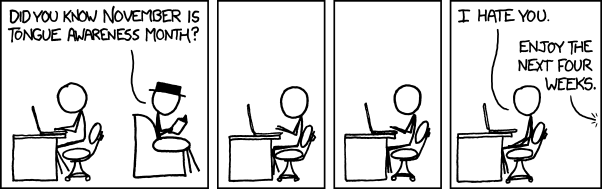
Apt cartoon by xkcd, about tongue awareness.
Wednesday, January 18, 2012
Two Years of Exposing OCD
It's Exposing OCD's blog anniversary! I've been writing this blog for two years. I am grateful for all the readers who contribute to a rich community of comments, and for those who read these words, and go on to start their own blogs. My blog roll has gotten longer and longer, and this makes OCD less isolating and lonely.
November and December were a struggle, and I pulled inward. The darkness, the cold, my back pain and subsequently spending much of my time inside and alone, contributed to depression.
Fortunately, when I called my therapist, in the midst of this lowness, he encouraged me to realize I am a social being, even if I am introverted, that I need human contact, and I focused on getting out of the house and meeting with friends or going to networking events. I also found someone who gives lessons in the Alexander Technique, who is also an artist, like I am, and he has been helping me with my posture so that when I am in the studio I don't aggravate my back.
In the mix with all this, I did my breast self-exam and felt an unfamiliar lumpiness, and started into a cascade of "What's wrong with you? Maybe you are just hyper-sensitive to your body, and that means you are a bad person. Or maybe you have cancer, and it's all your fault. . ." and on and on. I was able to wait a week or two, and do my self-exam again, to make my best guess, since I still felt something, and make an appointment to see a doctor, not knowing for sure if it was OCD-warped perception, or something wrong.
The doctor couldn't feel anything. In the past, I would have had a panic attack about how stupid I was to go, or find another doctor to make sure. He did prescribe an ultrasound, and then my annual mammogram which came back normal. I have a follow-up appointment in February. That I can deal with potential health problems is really big, and as much as I hate the uncertainty, I know I have much more ability to cope with it. I am reading a book, Present Perfect, about perfectionism and the author says that if we are alive, we are all survivors of uncertainty. Uncertainty is all around us, but OCD hones in on certain ones, and says, "If you don't know this, you can't go on" but we go on all the time--we just don't realize it.
Sunday, November 20, 2011
Back Pain and my OCD.
I put my back out this week. I struggle with the presence of physical pain and the OCD that swoops in to complicate it. The first time I hurt my back, I was all of 24, and visiting my father for vacation. He asked me to vacuum the floor, and by the next morning, I couldn't get upright without my muscles seizing up. I'd never felt anything like it, but I knew that it had to be my imperfection and general deficiency that caused it. Having compassion for myself was not something that came easily, if at all. I had recurring back pain all through my 20's and into my 30's. I did have some physical therapy finally, when I was starting grad school, and the MacKenzie back exercises helped. But I went everywhere with a back pillow, and sat near the aisle so I could go stand up during concerts or lectures. I lived in fear of situations where my back might go out and there would be no way to get relief, or that I would be humiliated by my weakness.
I planned everything around how long I had to sit. I knew where the straight hard chairs were in any place I went to frequently. Once I graduated, and started a new job, my back seized up to the point that I had my husband drop me off a few blocks early to give me a chance to get fully upright before I got to the front door. I was depressed. I was anxious. Once my health insurance started, I went to a physiatrist, and got a referral for more physical therapy. This calmed my back for awhile, but the flare ups continued for a few more years, and then slowly, as I was doing therapy for my depression with Molly, my back stabilized. It seemed like a miracle.
On occasion, my back would get stiff, but recover quickly. But this week, after many situations of uncomfortable chairs--getting my hair washed at the beauty shop(which I do about once a year), meetings, long car trips--and lots of time in the studio, my back protested. I've started my Mackenzie exercises again and that has given me some relief, but I still have 3 more craft shows to get through, and the place I feel worst is in my studio, which is frustrating me, and I feel sad that what I love to do most, make art, is where the pain is aggravated. My OCD is all over this, and the more anxious I feel, the more I do things that make my back hurt even more, rituals of sitting at the computer too long. Slowing myself down is hard. The perfectionism is always in the background shouting about my need to do everything exactly right(whatever that means, since the standard always changes). I am working on it though. And know I may need to go back to the doctor and ask about occupational therapy.
If you have chronic pain and OCD, what helps you? I'd love to hear.
Subscribe to:
Posts (Atom)