Thursday, July 9, 2015

Though Your Hands May Tremble: Dr. Claire Weekes and Peace from Nervous Suffering


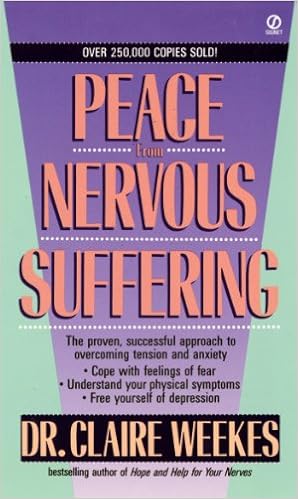
Discovering the Anxiety Coaches Podcast led me to rediscovering Dr. Claire Weekes(1903-1990), the pioneering Australian physician who wrote about how to float through anxiety in the 1960's. When I was in the depths of anxiety, I found a book by Claire Weekes at the library.

I recognized a kindred spirit right away.  She had suffered with anxiety(or as she puts it "nervous illness"), and knew how disruptive and painful it can be.  Dr. Weekes is clear that we are not alone in suffering anxiety, and we are not fundamentally broken or flawed.

Listen to her voice in the video below.  Though it reminded me of old movies in tone, it did not subtract to her thorough understanding of the panic cycle which feeds on "what if."


Claire Weekes Biography

Two Pieces of Peace from Nervous Suffering by Summer Beretsky


Wednesday, June 10, 2015

The Anxiety Coaches Podcast


I discovered The Anxiety Coaches Podcast last year, but in true avoidance style, only listened to one episode.  This month I started listening regularly, and am reminded again that I fall into avoidance when I am anxious.  My anxiety is highest when I wake up, and my well practiced habit is to stay in bed, get on the internet or become critical of myself for not doing enough.

OCD is an anxiety disorder, and it has been helpful to listen to Kevin and Kelli talk about the symptoms of anxiety, reminding me that I don't have to believe the sense of urgency some of these symptoms bring with them.  The Anxiety Coaches talk about their own anxiety ~ panic, PTSD, generalized anxiety ~ and although the focus is not about OCD, there is much to be learned about the common elements of different manifestations of anxiety.

The Anxiety Coaches also have an Anxiety Card project:

We would love for you to anonymously contribute your anxiety story to a group art project. You may tell the story of how your anxiety started, what triggered it, a major impact it has had on your life, or anything else you think is important.
WHY?
When it comes to anxiety relief, one of the most important factors is validation...knowing you are NOT ALONE. If we all share our stories we can reach some of the millions of people out there that are suffering in silence and too ashamed of what they are going through. They deserve to know that they're not weird, they're not crazy, they in fact are going through things many of use have gone through. Let's all stand together to fight the stigma of anxiety disorders!

Check out The Anxiety Coaches Podcast.

Sunday, May 17, 2015

Five Years of Exposing OCD

Dream by Nutmeg Designs


The other night I had a dream that I was filling out a survey and the man across the table said he couldn't do it, that he was overwhelmed with deciding what to answer.  I leaned over and suggested that he guess.  Immediately, I realized that this would sound "easier said than done," and I made the decision to tell him that I knew it was difficult when obsessing to guess.  

I felt both anxious that I was telling him I knew what it was like to have OCD, and relieved.  I woke up with still imbued with both feelings.

When I started this blog in 2010, it was an exposure to the anxiety that I would write the wrong thing. I guessed what to say.  It sounds odd to say I guessed, but that's what it felt like, because anything less than perfection felt incredibly unmoored and tentative.  The community of readers, and other bloggers was sustaining when I struggled with pervasiveness of my OCD.  There is power in being able to articulate an experience, and strength in finding others who resonate with that experience.

I wrote this blog anonymously, because I couldn't imagine writing it any other way.  Lately, I haven't been writing the blog at all.  I am not sure where this blog is headed, but I know that the archives continue to speak to readers, and I am glad to be able to offer those as a trail marker.

I have been percolating about how my blog connects with the rest of my life, without the urgency of obsessive figuring out.  This feels both odd and good.

Thursday, December 18, 2014

The Mindfulness Workbook for OCD: Just Right OCD


I was glad to see a chapter on this form of obsession of doing things "just right, " also known as symmetry OCD, organizational OCD, and perfectionism OCD.  The authors get the fact that the opposite of "just right" feeling is "feeling dead wrong," which has emotional intensity.

The one compulsion that resonated the most with me was:

  • Checking to see see if things appear as you feel they should(for example, reviewing the placement of two pillows on a bed to make sure they are in the perfect position.)
When my health anxiety would be active, I would check whatever symptom I had against the opposite side of the body.  This summer I had a feeling of a something stuck in my throat, and my urge was to keep checking to see if my tonsils were parallel, and then feeling ashamed that I looked in the mirror, and berating myself for my vigilance.  

An Acceptance tool for Just Right OCD is allowing the "off" feeling to be there, noticing the body sensations, and carrying it with you "on your way to doing something greater than your compulsive fixing."  

An Assessment tool for Just Right OCD is dealing with all or nothing thinking.  When I used to sew for Home Ec class, I would become so fixated on any small asymmetry of top stitching, and therefore the whole garment was "ruined," even though other people would have a different frame of reference, and not even notice the stitches, but rather overall shape of the garment.  Ironically, I won an award for excellence in Home Economics in 9th grade, even as I was convinced any flaw meant I was incompetent.

Taking Action for Just Right OCD includes recognizing that focusing on perfection can mean a tiny trigger can feel as disturbing as something more obviously huge, so setting up a hierarchy of exposures can seem impossible.  

It's important to get in there and take any opportunity to let things feel "off" rather than trying to fix it.   Trying to decide if I had a hierarchy of exposures "just right" could take up all my time and it helped that my ERP therapist understood this and encouraged me to practice tolerating the thought that I might do my exposures wrong.  


Tuesday, August 12, 2014

Summary of Part 1 of The Mindfulness Workbook for OCD by Jon Hershfield and Tom Corboy.


New Harbinger Publications offered to send a review copy of The Mindfulness Workbook for OCD by Jon Hershfield and Tom Corboy(2013).  Since I was in the middle of taking a mindfulness class, it was interesting to read this book with specific connections to OCD.

I am familiar with the writing of Jon Hershfield, as he was the moderator of the online support group PureO for many years, and he had a way of describing obsessive thoughts and ways to face them that was very helpful.

Part 1 covers definition of mindfulness and cognitive behavioral therapy(CBT) terms.

The authors define mindfulness as, "the state of acknowledging and accepting whatever is happening in the present moment exactly as it is(p. 8)."  In my experience, when I have an anxious thought or sensation, I race way ahead of the present moment in trying to figure out what it is or what it means.

The authors argue that, "The problem of OCD isn't that you think too much.  It's that you confuse the intensity, volume or visibility of your thoughts with their importance(p. 12)."  Practicing hanging in there with the intensity or stickiness of the thoughts can allow your mindful self to choose what you want to do with your life, rather than listening to the loudest voice.

The book provides a cognitive behavioral therapy background on distortions of thinking that you can identify in your own thoughts, not as a way to "solve" or "figure out" the thoughts, but to practice seeing them as thoughts.  One of the things that really helped me when I was in therapy for OCD was writing down my thoughts as they happened, as if it were a transcript, but then labeling the distortions in the margin, so I got better at identifying what my mind was up to.

One such distortion is Catastrophizing/Predicting/Jumping to Conclusions.  Accepting I can't predict the future is a bedrock of mindfulness.   As scary as the uncertainty can be, the racing ahead brings forth even more fear.

The book does an overview of Exposure and Response Prevention therapy, and the use of Imaginal Exposure Scripts, another component that helped me in therapy.

Part 2 of the book addresses mindfulness and CBT for specific obsessions with a 3 step process.


  1. Acceptance of the presence of OCD thoughts and feelings.  You are accepting that the thoughts are there, not any meaning that you attribute to those thoughts.
  2. Assessment using CBT to assess the value of the OCD thoughts, as a nonpartial observer, labeling possible distortions, and returning to the present.
  3. Action using behavioral skills to expose yourself to OCD thoughts in order to habituate to them and overcome your fears.
I suspect many readers will turn immediately to Part 2 in hopes of clues to particular obsessions, as the authors say, "The reason we separate obsessions into categories is that for every obsessive-compulsive cycle, there's a way to break it.  There's a way in, and knowing the way in is important  When you understand the mechanics of an obsession can identify the compulsions that hold it in place, you can begin the process of letting both of them go(p. 84)."

I will discuss some of these chapters in future posts, as well as some thoughts on the book as a whole.  


Monday, August 4, 2014

Making Room for Your Life: TEDx Lincoln Talk with Khara Plicanic


I came across Kara Plicanic on Instagram.  She is a wedding photographer with a creative eye, and I was intrigued that she had done a TEDx talk called Anything is Possible ~ and That's the Problem.  Or is it? about her experience with OCD.

She recommends reading Jeff Bell, and I concur that he is an eloquent writer and speaker about facing OCD and making a life.

It helps to find kindred spirits who are artists as I am, and who have made room for their creative spirit amidst the crowding of OCD thoughts.

Sunday, May 11, 2014

Dealing with Health OCD as a Teenager

I received a poem written by a 16 year old girl who suffers from OCD, and she gave me permission to write about it on my blog.  I feel kinship with her, since I was in the midst of health anxiety OCD at her age.  I didn't have the internet to look up symptoms, but I went to bookstores and libraries and read medical reference books.  I am including a few excerpts from Eliza's poem: 


OCD

In a crowd, it seems impossible to feel so alone . . .
I tell my friend I have a sharp headache,
And I wonder if she knows that the second class lets out
I will immediately look up symptoms
And pick the worst disease
And that I will convince myself that I have
A brain tumor

***

It’s this stupid disease,
That makes me obsess over a single worry,
It’s this stupid disease,
That makes me think I have a million others,
It’s this stupid disease,
That makes me hate myself

But I continue, and no matter how hard it can be
I get through it
And because the worry and fear overcomes me,
It just makes it all the more welcoming
When happiness
Knocks the wind out of me


Health Anxiety OCD is indeed the "stupid disease/that makes me think I have a million others."  I hated myself at 16, hated how quickly and intensely I would worry about pains and spots on my skin and symptoms of any kind.  I believed this was a defect in myself, that I couldn't control the worry.  

I had moments "When happiness/knocks the wind out of me" and these gave me a glimpse of hope that I could feel something besides fear.  

I had never heard the phrase "Obsessive Compulsive Disorder" or the acronym "OCD."  I knew I had anxiety, but that was it.  When I was 19 or 20, my mother was taking classes to become a counselor, and I picked up her DSM, a manual of diagnoses for mental illness.  I don't remember seeing "OCD" but "Generalized Anxiety Disorder" jumped out at me for describing much of what I experienced.  It was a relief that someone could describe this fear.  

The missing component was treatment, and it took about 15 more years until I was diagnosed with OCD and found an Exposure and Response Prevention Therapist.  There was a strong part of me that hung on, in spite of the fear, and I honor that part of myself and that of Eliza.  You are stronger than you know.