Showing posts sorted by relevance for query jeff bell. Sort by date Show all posts

Thursday, March 11, 2010

Jeff Bell's Rewind, Replay, Repeat: A Memoir of Obsessive Compulsive Disorder

I read this memoir as soon as it came out, and was moved by the author's honesty and ability to communicate what OCD is like from the inside out. Jeff Bell is an accomplished radio host, and kept his obsessions a secret from those around him.

He opens with the image of being 6 years old and driving past another car, with a little boy shouting "Hi!" and having an urgent need to know who the boy was and why he said hello, repeatedly asking his mother about it. I remember at age 8 becoming obsessed that I might need to go to the bathroom after I got into bed, that I would not be able to sleep if I had any pressure in my bladder. When I first got into bed I would bolt out of it over and over, feeling the compulsion to keep checking, keep attempting to empty my bladder.

OCD is relentless, and I could feel Jeff Bell's pain as he started fearing he'd hit someone while driving, and feeling compelled to go back and check the road. That he somehow functioned at all is amazing, with this other full time job of struggling with the OCD. It's like the relay a gym teacher had my class do when I was in the 11th grade--we were to put on a full set of clothes over our swimsuit, swim to the other side, take off the clothes and give them to next person in the relay. We did it because our teacher said to, and OCD wants that kind of power. It says, "Drive to work, but if you hear any sound, go back to make sure you didn't hit someone."

Scheduling your life around these demands is exhausting, debilitating and destructive to yourself and those around you. It's like swimming in waterlogged clothing. It's also paradoxical--if as a child I was afraid I wouldn't be able to sleep, repeatedly getting up to empty my already empty bladder made sure that I wouldn't be able to sleep, but in the midst of the intense anxiety created by OCD, I did what it commanded.

Jeff Bell has a new book, When in Doubt, Make Belief, which I am looking forward to reading. Let me know if you've read it.

Another Good Book:
Freedom From Obsessive Compulsive Disorder

Tuesday, February 1, 2011

The Purpose of Therapy for OCD vs. the Goal of Therapy for OCD

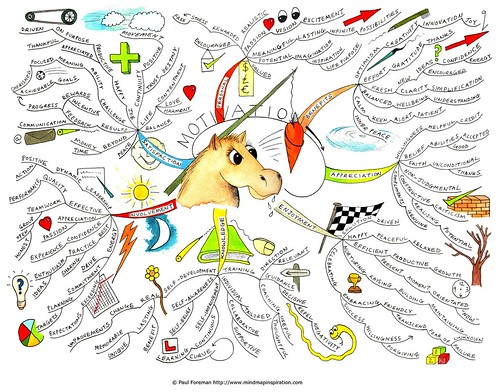
Motivation Mind Map
I remembered something the leader of my OCD support group said, "The goal of treatment is to live with uncertainty. The purpose of treatment is to reclaim your life." Sometimes in the short term all I can see is the goal of Exposure Therapy, which is to tolerate uncertainty until the anxiety recedes, or to use the fancy word, until you "habituate" to the anxiety. And often I read comments on the OCD Support Group that reflect a fear that the goal of Exposure Therapy is to suffer, "learn to live with the anxiety" or give up the possibility of any peace.

It helped me to connect the pain of doing Exposures with the purpose of doing them. My therapist didn't ask me to do Exposures just for the sake of doing them, or because it was "correct treatment"--he asked me to do them so I could reclaim my life. The first time I met with him, he listened to my history of having OCD, and said that OCD was a disrespecter of my person. I was struck by this. Much of what is important to me was lost inside the OCD. Connecting with what I value, love, am passionate about, gives me motivation to do my Exposures. I love making art, and this often gives me the fuel to defy the OCD pull toward compulsing, and therefore losing many hours in my day to rituals.

Jeff Bell, IOCDF Spokesman, in his new book When in Doubt, Make Belief: An OCD-Inspired Approach to Living with Uncertainty, argues that human beings are motivated by what they value, by making a difference, and doing things for the greater good:
As seen through the distorted lens of unhealthy doubt, "good"
choices are those that reduce our anxiety, while "bad" choices are
those that increase our fear and introduce uncertainty.
Some of the choices that I want to make, cause me anxiety, and my OCD tendency would be to label them bad, and this crashes directly into an essential part of my soul that knows I want to make these choices, that there are things I want in this life, things I desire to accomplish and experience. With OCD it's hard to inhabit your own life. When I think about all I've lost to compulsions, I feel a deep grief, but every Exposure I do allows me to move back into my own life.

What are some good choices that you've made that *increased* your anxiety, but which you chose anyway, because they were in the service of something important to you?

Related:
Jeff Bell's Memoir Rewind, Replay, Repeat
What do you want your life to be about? Action and Commitment Therapy for OCD

Monday, March 12, 2012

OCD: A Guide for the Newly Diagnosed: Review of Michael Tompkins' Book for Consumers


When New Harbinger Publications asked if I would consider reviewing Michael Tompkins book, OCD: A Guide for the Newly Diagnosed, I was heartened to know that there was a new book on this topic. The introduction is by Jeff Bell, who wrote an insightful memoir about OCD called Rewind, Replay Repeat, which I took to be a good sign.

The book fits nicely in the hand, and adds to the approachability for those who have just found out they have OCD. Actually, Tompkins starts with describing the process of getting a diagnosis, and I'm glad he addressed the difficulty of finding mental health professionals who are actually familiar with the many forms OCD can take. I would argue that the comprehensive diagnostic process described in this book really only happens with therapists who are specialists in OCD, or who have trained in Exposure Therapy, and have treated a lot of people with OCD. The therapist who diagnosed me basically said, yes, it sounds like you have OCD.

Tompkins does an overview of Exposure and Response Prevention Therapy(ERP), Cognitive Therapy, and medication as well as other treatments, as well as what questions to ask a potential therapist, and how to get the most out of sessions.

I particularly liked the chapter on developing a "Recovery Attitude" including accepting such things as uncertainty, imperfect outcomes, imperfect knowledge, learning to approach discomfort in order to get through to the other side, turning away from debate with your OCD, seeking support, not reassurance, and practicing everyday. As someone who has struggled with perfectionistic OCD, I constantly battled with the fear that I wasn't doing my treatment perfectly or that I didn't have perfect knowledge of my OCD. Tompkins points out that "good enough" treatment is indeed "good enough," and OCD is demanding perfection that doesn't exist.

The book closes with information about unhealthy coping, school and work issues, a list of treatment centers, and recommended reading. It's difficult to fit everything into an introductory book, an at times I wanted more detail, or found too much squeezed into a section, but overall this book would be an excellent addition to a public library's mental health collection, as well as college libraries and hospital consumer health libraries.

Michael Tompkins, PhD, is a licensed psychologist at the San Francisco Bay Area Center for Cognitive Therapy.


Tuesday, May 4, 2010

Stuck in my Head

Kei - Principles of Anxiety

Yesterday I was driving with a couple bowling balls in my trunk, and every so often they would give a lurching jolt as they clanked together. It made me think of Jeff Bell's account of his "hit and run" anxiety--a constant fear that he had hit someone with his car and going back to check the road--and how the bowling balls could provide an Exposure to that fear, with their unannounced thumping, and practicing driving on without turning back to check the scene.

Until I read about this OCD theme, I didn't realize it existed. That is the challenge with OCD. It's a shapeshifter, and can take an infinite variety of forms. Sometimes in my support group it was difficult for people to relate to obsessions that weren't like their own. It's so much easier to come up with Exposures for anyone but ourselves!

But there are more commonalities than appear on the surface. When I have an unexplained body sensation or symptom, I immediately fear something is wrong. I want to know what caused it and why it's there, just as someone might hear an unexplained noise while driving, and be afraid they hit someone, and want to know what the noise was, and that it's not dangerous.

I think about potential contamination scenarios quite frequently since I work in a hospital, but the thoughts don't stick. My OCD doesn't latch onto this very often. It's not one of my major themes, and the temptation is to assume that my health fears are more realistic or more painful, or more likely to happen, and that's why I'm worried about them. Some people get a song stuck in their head and can't focus on anything else, and fear going crazy. The OCD amplifies something that happens all the time, and sticks tenaciously.

Wednesday, June 16, 2010

IOCDF Conference, July 16-18th, 2010!

I am disappointed I won't be attending the International OCD Foundation Conference, July 16-18, 2010 in Washington, DC. I went 2 years ago when it was in Boston, and learned a lot. Part of it came from driving up with members of my support group and sharing a hotel room--lots of exposures in just being myself and tolerating the anxiety that comes with being an imperfect human. The sessions were good too, and it is amazing the number of people with OCD and their families and friends who attend this conference. It's not a closed academic conference. We are there and hold the professionals accountable and that must be a bit scary for some presenters! It's amazing to witness so many people learning about OCD and for the first time realizing they are not alone, and that there is treatment. If there's anyway you can attend, I would encourage you to do so!

Some sessions are aimed at therapists, researchers, some at people with OCD, kids with OCD, but you are welcome to attend any session no matter who you are. I was glad to hear thoughtful discussions from Renae Reinardy, Charles Mansueto, Jeff Bell, and Michael Jenike and I look forward hearing this year's sessions, including Fred Penzel talking about health anxiety, and Allen Weg, who writes a great column for the New Jersey OCD Foundation using metaphor as a way to help us fight the OCD.

I did go on the infamous Jon Grayson "Virtual Camping Trip," which is powerful for many people, as a large crowd moved through Boston, doing exposures for contamination, and harm fears. I think the exposure aspect for me was just being there, since my social anxiety was kicking up, and feeling awkward as what I "should" be doing.

If anyone is going or has been to a conference, I'd love to hear from you!

Monday, August 4, 2014

Making Room for Your Life: TEDx Lincoln Talk with Khara Plicanic


I came across Kara Plicanic on Instagram.  She is a wedding photographer with a creative eye, and I was intrigued that she had done a TEDx talk called Anything is Possible ~ and That's the Problem.  Or is it? about her experience with OCD.

She recommends reading Jeff Bell, and I concur that he is an eloquent writer and speaker about facing OCD and making a life.

It helps to find kindred spirits who are artists as I am, and who have made room for their creative spirit amidst the crowding of OCD thoughts.

Sunday, November 5, 2017

The Questioner Tendency and OCD


I just finished reading The Four Tendencies by Gretchen Rubin, and her telltale sign of being a "Questioner" is that you dispute the validity of taking the quiz to find out what your tendency is. . .Yes, that would be me. In fact, it was an exposure for me to take the quiz, and tolerate the anxiety that the framework might not be valid. To be able to still learn from Rubin's observations is part of the flexibility that has come through doing Exposure and Response Prevention Therapy.  Rubin's quest has been to find the motivations for habit change, whether you meet inner and outer expectations.

Questioners question all expectations; they’ll meet an expectation if they think it makes sense--essentially, they make all expectations into inner expectations.

The desire to research can cause decision paralysis in Questioners, and I believe that OCD can take this to an extreme in the theme of indecision and perfectionism. As I've written on this blog, indecision was a struggle because of the fear of making the wrong decision and being haunted by anxiety. My research consumed much of my time. My librarian training only added to this desire for more and more information.

Rubin notes some ways to help overcome analysis-paralysis.


  • Setting an action deadline
  • Following the advice of someone you respect
  • Limiting information sources
These ideas echo what Leonard, my ERP therapist advised. Because he was willing to answer my questions initially about OCD treatment, and point to the research on the success of ERP, I learned to respect him, and be willing to follow his advice. He knew I was a Questioner, and in addition to providing that initial information, explained that a pattern of continual questioning becomes reassurance and makes the anxiety worse by reinforcing it.

Flipping a coin was one strategy for setting a deadline, which I practiced at the grocery store.

Leonard would ask me to imagine what someone without OCD would do in a particular situation, and take my best guess as to the action to take. Yes, it is scary, but OCD promises perfect knowledge and perfect results and never delivers. 

Others with OCD might not be Questioners, but Upholders, Obligers or Rebels, and need different strategies to motivate themselves.

For an Obliger who meets others expectations but struggles meeting their own inner expectations, treatment for OCD could be more effective with accountability: exposure homework from a therapist, or attending a support group and having an accountability partner to call when a task is done. 

For a Rebel, who has struggles meeting both outer and inner expectations, accountability can aggravate the "you can't make me" response. Appealing to values and identity can help free up the oppositional pattern, as can framing exposures as a choice, not a demand. Jeff Bell has written about how focusing on what you value can give the impetus needed to face uncertainty and move ahead in spite of anxiety.

For an Upholder, who readily meets both outer and inner expectations, reading a book like Jonathan Grayson's Freedom from OCD and following his suggestions for Exposure and Response Prevention Therapy could make more sense to them than support groups or even therapy. 


Four Tendencies Quiz

RELATED POSTS

I is for Indecision

N is for Need to Know

An Imaginal Exposure Script for Indecision OCD

Indecision at the Library

Just One More Search: Information Overload and OCD