Saturday, April 6, 2019

OCD A to Z: S is for Scrupulosity and Obsessing about God, ethics, and sin

unforgiven

I remember reading that the word "scruple" comes from the meaning "sharp stone" and scrupulosity is like a sharp stone in your shoe, paining you with every step. Scrupulousness can be a form of OCD, with a sensitive conscience constantly jabbed by fears of committing sins, doing something wrong, making a mistake or being negligent. Scrupulosity means never feeling forgiven, redeemed or having any lasting relief from confession(if one is Catholic), or constant fear of eating something not Kosher(if one is Jewish), or fear of breaking the law, being dishonest, or unjust(whether religious or secular).

Compulsions could include repeated confession, constant checking to make sure items are Kosher, repetitive prayers, or rituals that seemingly have nothing to do with what you fear, but give you a brief relief from the fear. For me, going to church generated whirlwinds of questions, and sucked up my energy, and filled me with despair. I went to a very liberal church, and ruminated on whether I was going to hell because I believed being gay wasn't a sin, or that women could be ministers. I was afraid that my decision to go to this church was a mistake, even though in my heart, I couldn't go to any other church.

And of course, there are people who would say that really God was trying to get me to repent, that I really was making a mistake, that it wasn't OCD at all. This is where faith comes in, the faith to believe what I know in my heart, in spite of the intrusive thoughts, and the collusion of some preachers and teachers with what my OCD is saying. I also suffered from fears of being a bad person, outside of any particular theology. An excellent article is Scrupulosity: Blackmailed by OCD in the Name of God by Laurie Krauth, who describes this type of fear:
Some people—religious and not—experience scrupulosity as an irrational moral perfectionism. I’ve heard them describe the fear of getting “in trouble” for making a non-existent or unlikely error for which they would be punished. A businessman obsessed about having told a colleague that he had read a book when in fact he had skimmed one of the chapters, and agonized over how to clarify “the truth” to his colleague.
There is part of me that knows God is bigger than my OCD fears. There is part of me that knows I have intrinsic worth by virtue of being human.

Thursday, April 4, 2019

OCD A to Z: R is for Relationship OCD

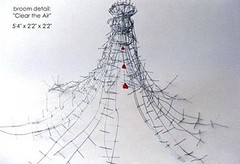
clear the air detail copy


I'd never seen the acronym ROCD before until I came upon it on a OCD self-help list called Stuck in a Doorway. It stands for Relationship OCD, and another one was HOCD for Homosexuality OCD. They are both ways that OCD latches onto whatever is important to us.

OCD wants definitive answers, and when an obsessive thought or question centered around being with the right person(ROCD) or gender(HOCD), my desire was to answer the questions so I could breathe, so I could not be vigilantly checking to make sure I was making the right decision, and not be haunted by it later.

I was shy, and didn't date in highschool. I had a friend who lived in a cooperative community and most of her mother's friends were lesbians. This friend and I loved talking about big questions, the meaning of life, the nature of history. She gave me feminist theorists to read, and I gave her books by Madeleine L'Engle and C.S. Lewis. She didn't believe in God, but I wanted to be a minister, but we still talked for the enjoyment of spirited talking. She didn't date either, and rumors abounded that she was a lesbian. We went to see Entre Nous, a French movie about a woman who leaves her husband for another woman. This haunted me, because my father had left my mother that year, when I was 16 and my sister 13. My friend said that this woman as becoming free, but I kept seeing the shot of the daughter waiting for her mother.

I moved away after I graduated, and she gave me 3 cassette tape of "Womyn's Music" to listen to, Meg Christian, Ferron, Chris Williamson, Sweet Honey in the Rock, and I loved the songs. Reading about women in history was one of the few things that kept my interest in college, and I ended up majoring in feminist theory, but slowly this evolved into a way to try and figure out if it was safe to be with a man. I had fallen in love, with a man, and my OCD was tenaciously throwing out barbed questions that perhaps I was a traitor to my gender. I wondered if the feminist songs I loved meant I was a lesbian, or the many women friends I felt safe with or found attractive meant that as well.

In spite of all this rumination, and reading and analyzing, I agreed to marry the man I was in love with, at age 25. My OCD fears were that marriage was inherently dangerous, and I would be mocked by those who came after me for being part of that institution. It took all I had to carry through when we went to apply for a marriage license, and the form said that $25 of the fee went toward a fund for victims of domestic violence. I didn't know I had OCD, but I knew I was filled with anxiety, and I clung onto the fact that I couldn't imagine being with anyone else, and that I had to ride through the anxiety, and that without getting married, I would have no health insurance after I graduated.

I used to wonder if I was suppressing my "true" self by being with my husband, but the exposure of being married, and enjoying his company until the anxiety subsided helped my obsessing about this to recede to the background as my health anxiety and perfectionism came to the forefront and sucked up much of my energy and life.

After I had my hair cut short, I remember some people calling me a boy, but how I looked didn't determine who I was. My fears didn't determine who I was. The healthy part of me knew I loved the man who became my husband.

If you've read this far, take courage. OCD can be treated with Exposure Therapy. You can learn to listen to the voice within you that knows who you are. You can learn to deal with your evolving self. No one gets a lifetime guarantee that they've chosen the right person or right gender. Just look at the divorce rate. OCD compulsions of analyzing and checking and figuring out will corrode a relationship, causing the very thing we fear, the loss of love, the fear of haunting memories.

Tuesday, April 2, 2019

OCD A to Z: Q is for Questions

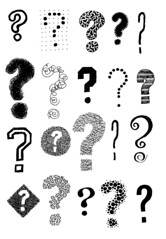
Question Marks

Questions are a defining aspect of OCD for me. Something about an unanswered question creates more anxiety for me than many statements of scary facts. "What if that bump on my ear is skin cancer?" kept me suffering more than when the doctor told me it was skin cancer, especially since I obsessed about the bump for 5 years. But then OCD in its opportunistic way turned its attention on "How could I have obsessed about this for 5 years? Why didn't I go to the doctor? What if this means I am a negligent irresponsible person?"

As a girl it was, "What if I am drafted into the army?" or "What if I can't fall asleep because I feel like I need to go to the bathroom?" In highschool I had "What if those earrings I bought my mom for her birthday look like sperm and she hates me for that?(that particular obsession seriously sucked)" and "What is that red dot on my lip?" In college it was, "What if I am meant to be with a woman rather than a man?" or "What if it too dangerous to be with a man, and I should break up with my boyfriend?"

As an adult it was "What if my beliefs are wrong? What if it really is a sin to be gay or have sex before marriage?" About this time, the internet became freely accessible, and I searched for answers to these questions, like turbo charged trips to the library reference section, searching without boundaries. I rarely asked my questions of other people. I focused on finding the answer myself, but whatever answer I found was not sufficient to stop the questions. Many questions in life have no answer, or inadequate answers, or painful answers.

OCD gave me the illusion that I could find a good answer to every question I had if I just looked diligently enough. At one point I decided it would be easier to say God didn't exist than to keep trying to find answers to my theological questions, and my therapist said that she believed God would understand how much pain I was in that I would be pushed to this point.

What kind of effect do questions have on you?

OCD A to Z: P is For Perfectionism

perfectionism

Perfectionism is a big part of my OCD. One of the biggest obstacles to doing Exposure and Response Prevention Therapy(ERP), is looking for "perfect" ways to do it. I've had some readers query whether I actually have Obsessive Compulsive Personality Disorder(OCPD) rather than OCD, because of all the posts I've written about perfectionism.

My understanding, via my therapist, is that there is an element of finding perfectionism to be pleasing rather than painful in the case of OCPD. My impulse is to look this up, but I've looked it up in the past, and I know the familiar trap of wanting to get everything just right.

As a child, I decided that I could be loved by my family only if I never made a mistake again, and I strived to always to get things right on the first try, or I would procrastinate, in order to avoid failure and the feared consequence of becoming worthless and unloveable.

Avoidance became one of my major compulsions, as OCD got its claws into my fears, ever the vulture circling. The most frustrating aspect was that often I didn't even know what "perfect" was in any given situation, just that whatever I was doing was "imperfect."  It was a moving target, always changing, and if I finally felt "aha, that's it" then my mind would generate some other aspect needed to make perfect.

It's been a battle accepting that my mind will probably continue to generate thoughts of not being good enough, or done, or finished, or that I've ruined a day, or my life. But I also see that I don't have to jump when these thoughts arrive, scrambling to fix things, make things perfect.

Perfection is a corrosive illusion. The "Perfectionism is actually an advantage" truisms used to send me into compulsive searching to find out if this was really true, because I could never be wrong, always had to figure things out. But I know from experience that perfectionism is most likely to prevent me from getting things done, keeps me searching for photos on flickr past the first couple pages, or delaying writing posts until I find the "right" topic. I have met amazing readers with OCD through this blog, in all its imperfections, and offered some hope, and that is what keeps me going.

Monday, April 1, 2019

OCD A to Z: O is For Only Obsessions

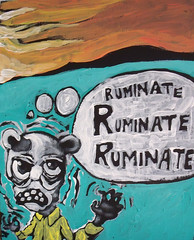
ruminate

When you don't appear to have any physical rituals, it seems very logical to assume that you only have obsessions, and no compulsions. This is where the "Pure-O" label originates, in the idea of being purely obsessional. What I have discovered in treatment is that compulsions or rituals that take place in my mind are every bit as real as those that are visible to the rest of the world.

Compulsing is the glue that makes an obsessive thought stick(after the initial hit of relief). It reminds me of times I have tried to fix something I perceive as a flaw, and ending up making it worse, because the thought of walking away without trying to get rid of it seems too anxiety-provoking. There are some thoughts that if I imagine letting them pass, I get very anxious, because I must make sure they aren't true, or I believe they say something about me as a person.

If I get involved in the battle against them, I lose every time. Going over conversations in my mind, reconstructing what I said, analyzing, ruminating, mental acrobatics. I left a comment on a friend's facebook wall and suddenly thought "What if this is rude?" and my urge was to try and establish if it was indeed rude, over and over. In the past I would've gotten stuck on this and lost a chunk of my day, or tried to find a way to see if the other person thought it was rude and on and on.

Other of my rituals actually are physical, but I never thought of them that way. Looking things up on the internet is an actual activity, as is avoiding certain things(for years I didn't watch the news or listen to the radio), or long sessions of writing in my journal analyzing everything.

Once I learned to identify my compulsions, it was easier to figure out what an exposure was, and what "response prevention" means in Exposure and Response Prevention therapy. So, I accepted that my facebook comment may have been rude, felt some anxiety, and moved on instead of analyzing every angle, and the anxiety moved on as well.

[Revisiting OCD A to Z from 2011]

OCD A to Z: N is Need to Know

Searching for answers.

"Need to Know" OCD has been a giant time-suck. My mind generates a lot of questions, and for many years I assumed I must therefore find the answer to these questions, even if it was totally irrelevant to what's important in my life.

The compulsion is the search for the answer, because of the threat of feeling gnawing anxiety at not having found the answer, and fear that it will take up all available space in my head and that I'm missing something important.

Some people might blame this on the internet and smartphones, but all I needed was my mind. I'd forget someone's name, and wrack my brain trying to remember it, or dig through all my journals to find it. I'd go to the library and look at reference books. It didn't help that for 15 years I actually was a librarian, and I was trained to find things out! I was good at my job because of my honed skills of tracking information down, but got bogged down with finding too much information, not wanting to miss anything.

Yes, many folks have difficulty with getting sidetracked on the internet looking up random stuff, even without OCD, but OCD makes it feel dire if you don't hunt for an answer or find a missing link or recover a fragment of memory. 

I am learning to accept that my mind will be generating questions. That's what it does. Part of what makes me a writer is that I have a lot of questions and observations about the world. But if I follow every question down the path of finding an answer there isn't time for much else. It's hard to let some things go. I had the illusion that I really could find the answer to any question I had, but some can't be answered. But it is an illusion, and if I can remember that, and practicing letting some things go unanswered, it gets easier to let them pass.

[Revisiting OCD A to Z from 2011]

Sunday, March 31, 2019

OCD A to Z: M is For Medication

seratonin and dopamine went walking


I knew I wanted to write about medication as my M word, but I felt anxious about it. My path to taking medication was long and convoluted. I'm up to Part 7.5 of my medication story, as you'll see from the list of posts below. In Part 7.5, I had been off my SSRI antidepressant(pitifully low dose for OCD) for several months, and increasingly trapped in my anxiety about my body.

My incessant seeking of answers about my symptoms led to more medical tests, including a biopsy and a freak accident, after which I could barely sit or walk, and all manner of bandaging as the wounds slowly healed. I've never experienced pain like that before. Getting in and out of the car was an ordeal. Yet in the middle of this crisis, I realized I needed real help, and I found a therapist on the International OCD Foundation list, who specialized in Exposure Therapy, and made an appointment, just a week after my injury. I drove 1.5 hrs through traffic, in raw pain, and limped into the therapist's office. I was trying to sit on the couch and talk about my symptoms of OCD, while feeling like a freak.

This Exposure therapist referred me to another therapist in the practice, Leonard, who helped me change my life. I had gone back on my tiny dose of the SSRI after finding out my sister-in-law had had a heart attack at age 49, and the health anxiety was more overwhelming than my fear of medication. Leonard advised me that OCD often responds to larger doses, and with my doctor's approval, I slowly ramped up my dose of the course of a couple of months to the maximum. Leonard didn't patronize me. He didn't throw meds at me. He helped me to see that in order to do my exposures, and have some breathing room from the OCD, that a high dose could aid that. I'm still on that high dose, and in the process of slowing down my ERP therapy, as I've made tremendous progress. In the past my OCD would be agitating to get me off meds right now, because of needing to know right now if there are long term effects. I still get those thoughts, but if I go off the meds, it will be on my terms not the OCD's, and for now, the benefit of reclaiming my life is enough.

[Revisiting OCD A-Z from 2011]

Part 1: OCD and Medication Decisions
Part 2: Starting Medication while Struggling
Part 3: The Limits of Research in Medication Decisions
Part 4: My First Prescription for SSRI's
Part 5: Feeling it in the Jaw: Side Effects of Medication
Part 6: Being on Medication & OCD Weeping
Part 7: Wanting to Get off my Medication
Part 7.5: Built on Sinking Sand: OCD and Health Anxiety