Friday, June 22, 2012

Interview with Andrea Kayne Kaufman, Author of Oxford Messed Up: Part 1

Andrea Kayne Kaufman, author of Oxford Messed Up, graciously agreed to answer some questions about her novel, which deals with OCD.

ExpWoman:  "What if" questions are a hallmark of OCD, 
usually with dire answers.  Your novel seems to be a 
"What if" with an optimistic answer.
How did the scenario of Henry and Gloria 
meeting 
come about?  As a "what if" of an extraordinary kind 
or did one of the characters come first?

Andrea: Gloria came to me when we were struggling with ocd with one of our children. There were some people close to us who doubted the efficacy of the medication and cbt/erp therapy we were going to embark on. They told us our child would be fine. Was so smart. Would go to yale and find his niche eventually.  That wasn't good enough for us as we watched needless suffering. So i think that is why i created gloria.  The "perfect" yale graduate, living a miserable existence.

After our child got better (very quickly by the way), Gloria seemed to be asking for her happy ending too.  I created Henry because our child's therapist once said that what seems like the worst thing possible may actually be the best thing possible. So that is why i gave Henry his condition, the worst germs possible.


ExpWoman:   What led you to have Henry be the agent of the 
Exposure Therapy(ERP) rather than a therapist?

Andrea: Henry or any lay person is not an ideal person to administer erp.  But given Gloria's parents undermining of her early erp and history of hospitalization, she has been closed off to full treatment for years. Henry is able to open her up to the process again. His efforts are supervised by his sister (unethically perhaps) and i tried to show in the chapter with the dog that Gloria realizes Henry needs to be replaced by a real professional.  In order for the erp to be successful, you need patient buy-in and Henry is able achieve buy-in.

ExpWoman:  Some of my readers, 
most who struggle with OCD, wondered at the
speed of Gloria's recovery from her contamination OCD 
after she begins doing exposures with Henry.  
I know that my progress for health anxiety, 
intrusive thoughts & perfectionism has taken longer.  
What led you to a more rapid progression?

Andrea: Our family experience was that once we started medication and cbt/erp rigorously and consistently, we saw dramatic reduction in compulsions within 3 1/2 months. That doesn't mean the ocd has gone away. It's a life long struggle that can be triggered with all sorts of life events, hormones, stress etc. Although, it can rear its head, it has never been as strong because we have the tools.  The novel was vetted by three experts and has been hailed by the ocd community. There may be some poetic license but i really wanted to show the true torture of ocd from the inside out and how cbt can be very effective. Some people think that it is archaic and cruel, denying someone the few things that provide comfort. But cbt is the only therapy proven to really work and if done well, it can work quickly.


ExpWoman:  Which books on OCD were most helpful to you in writing this novel?

Andrea: 

The Boy Who Couldn't Stop Washing By Judith Rapoport

Ocd In Children And Adolescents By Johns S. March And Karen Mulle

Freeing Your Child From Obsessive Compulsive Disorder By Tamar E. Chansky

What Do Do When Your Child Has Obsessive-compulsive Disorder By Aureen Pinto Wagner

Talking Back To Ocd By John S. March

ExpWoman:   Did someone in particular inspire you 
to take on the subject of  dealing with OCD?

Andrea:  As I said before, we experienced very bad ocd with one of our children whose courage and tenacity really inspired me. Also, his psychologist Amanda Holly (whose video is on my website) is my total hero. She is our "ocd whisperer" and really saved a life and our family. She is one of the experts who consulted on the book.

ExpWoman:  I grew up as the daughter of an English
professor, and then did an MFA in creative writing. 
Being in the academic world had its own set of challenges 
when suffering from OCD.  What insight would you offer to 
those readers who are currently in academia and struggling?

Andrea:  Academia can definitely be daunting for anyone and especially for those who suffer from anxiety disorders like ocd. Moreover, whether you are a student or faculty member, the work in school can be isolating which can lead to stoicism, keeping all the struggles inside until they build and build. It is so important to have good mentors and advisors that you can share with— not just academics but also social/emotional struggles. It is also important to know that transitions to college or going through tenure can trigger internal stress and anxiety disorders. It is good to be prepared and prophylactic.  Finally, the world of academia emphasizes grades, publishing, comparing, competing. This dynamic is not healthy for the person who suffers from perfectionism whether in ocd form or eating disorder or something else. It is so important to master the "good enough" standard and learn to be gentle with ourselves.

ExpWoman:  I will post Part 2 of the interview with Andrea Kayne Kaufman next week.  For Andrea's introduction to Oxford Messed Up, check out her video.

Monday, June 4, 2012

Finding Hope in the Midst of Anxiety and Obsessing: It IS Possible

Hope Mosaic by Exposure Woman

Awhile back, one of my readers asked if I would post some of my art.  This is an even bigger exposure than making a video about my OCD for my last post!  As I wrote in Your one wild and precious life, my love of art gives me strength for facing my OCD.  The joy I feel when making art is something that allowed me a glimmer of hope that my life could be my own, rather than in the thrall of OCD.

Hope means looking forward to something, and some suggest that it is related to hop, to leaping in expectation.

The first time I read an article by Jonathan Grayson about obsessing about obsessing, I felt a leap of hope that someone understood what I was experiencing, the angst that I would do something to trigger my obsessing, and trying to figure out if I really was obsessing.  Grayson believed that exposure therapy could work for obsessions of the mind.

Meeting my exposure therapist, Leonard, for the first time also made my heart leap with hope.  He was a worthy foe of my OCD.

None of these things meant I was certain I'd get better or that someone could help me or that I could do exposures and survive them.  OCD had been demanding I be certain for quite some time--certain I had OCD, certain I had the right therapist, certain I was doing my exposures correctly--and this eroded my hope in the guise of helping me.   If your OCD is anything like mine it may sound like this:

You don't have enough hope.  You'll never get better.  What are the signs of hope in your life?  Figure that out.  Do a search on the effects of hope on dealing with mental illness.   What is wrong with you? Why do you feel despair?  You'll never get better.  
Whoever you are, if you suffer with anxiety and the exhaustion of worries chasing each other, remember that there is hope.  It is possible to get better.  It is possible to claim your one wild and precious life.  You are not broken, irredeemable, beyond mending or repair or healing.  If you don't have hope, you can borrow some of mine.


H is for Hope

Monday, May 21, 2012

Living with Me and My OCD: An Interview for Claire's Documentary


ClaireJaneOCD on twitter is creating a documentary about the experience of having OCD, and invited me to contribute a video.  Claire and Jane are twins in the UK, who just completed running a marathon in order to bring awareness about OCD.  This is my first time recording myself!  And definitely an exposure to make it, but hopefully will be helpful to other people who struggle with OCD.

Wednesday, May 2, 2012

Review of Oxford Messed Up by Andrea Kayne Kaufman: Facing OCD


[Note: In celebration of love, life and hope, Andrea Kayne Kaufman will be offering the Ebook edition for $ .99 on Amazon from May Day thru Cinco de Mayo - May 1-5.]


When Grant Place Press contacted me about reviewing Oxford Messed Up by Andrea Kayne Kaufman, little did I realize the connections I would find with my own life.  The protagonist, Gloria Zimmerman, is traveling to Oxford to study feminist poets, and struggles with OCD.

I have a degree focused on feminist poets.  Reading poems written by these women, and writing my own poems gave me strength to deal with depression, OCD and other pain.   I was a very serious young woman, who didn't know she had OCD, but knew that I was often scared about symptoms in my body, and trying to be perfect.  Gloria knows she has OCD, but attempts to keep herself together with rituals, Klonopin, and Van Morrison's music.

Van Morrison's music is a source of strength to both Gloria, and her "loo-mate" Henry Young(the other protagonist who has had many traumas in his life).   As a girl, I  remember sitting on the floor going through my parents record collection, trying to understand what a Moondance was, and mesmerized by the album.

I was intrigued that one of the recommendations on the back of the book came from Susan Richman from OCD Chicago, a chapter of the International OCD Foundation.  Oxford Messed Up does indeed explore Exposure and Response Prevention Therapy(ERP), the standard for treating OCD, and is the only novel for the adult market that I've ever come across that does.

Henry is the catalyst for Gloria's ERP, and this shows the importance of rapport for willingness to do Exposures.  If I hadn't trusted my ERP therapist, I wouldn't have done any of the Exposures he suggested.  I believe that family and friends are often on the frontlines of working on Exposures with the ones they love who have OCD, and that self-help has been very important for many sufferers, especially Jonathan Grayson's book Freedom from OCD, and his model of GOAL support groups.

At the same time, though, I was ambivalent about Henry's quick study of ERP, and how unrealistic this might be.  I was able to suspend disbelief because I remembered reading somewhere that ERP, even incompletely done, can be better than years and years of talk therapy. I only wish more therapists were  quick as Henry--like the 6 or 8 of them I saw before I found Leonard, who actually specializes in OCD and was expert in Exposure Therapy, rather than asking me to simply avoid my triggers or use logic to make it all go away.  I would imagine a novelist's dilemma would be how to portray a series of ERP sessions with a therapist, in a way that would make good fiction.  

Gloria has contamination OCD, which I don't have, and which gave me a brief flash of disappointment, because this is the stereotype of people who have Obsessive Compulsive Disorder.   But she also has perfectionism, a mandate to be a "Superstar,"  which I identify with, and I liked that Kaufman showed how perfectionism can underlay everything, and that this may be slower to respond than other aspects of OCD.  If patterns have been in place for a lifetime, through family culture, personal history, combined with genetic heritage, that simply habituating to the "dirty world" isn't enough, and that compassion, love, understanding and hope are crucial to regaining a life that has been ordered by taking as few risks as possible, and trying to earn the love of others.  

I recommend Oxford Messed Up for it's improvisational dialogue both internal and external, for an inside look at the OCD thought process while facing fears, for the importance of hope, and of "fatalistic optimism"(as the characters describe the music of Van Morrison).

In celebration of love, life and hope, Andrea Kayne Kaufman will be offering the Ebook edition for $ .99 on Amazon from May Day thru Cinco de Mayo - May 1-5.


Sunday, April 22, 2012

How do you talk to friends about how OCD affects you?

looking out


In a comment on a recent post, a reader asked the following question:


I have a question for anyone reading this ... how do you let others know about your OCD so they can cut you some slack? 
I only recently realized how much this disorder messes with my daily and weekly functioning. I thought I had adult ADD but it's anxiety, not ADD. 
I live alone and my "circle" does not have any idea how much energy it takes me, sometimes, just to get out the door. Any advice on how to help them to help me would be great.
For myself, I told very few people about my OCD.  My husband, my best friend, people in my OCD Goal Support Group and then as I started Exposure Therapy, a couple more close friends.  With my husband, it helped that he was willing to read Jonathan Grayson's book Freedom from OCD.


I'd love hear what other readers have to say about how to talk to others regarding your OCD and how it affects your functioning.  

Sunday, April 15, 2012

OCD Recovery as a Continuum Rather than All or Nothing

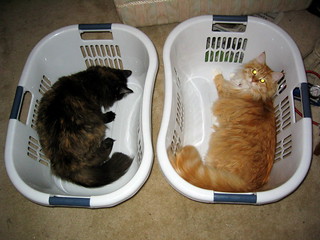
Two laundry baskets, two cats.

Right now I'm reading Monica Ramirez Basco's book Never Good Enough, about dealing with perfectionism. She is a cognitive behavioral therapist(CBT), and describes common thought patterns for people who are perfectionists, including "two basket thinking," where everything either falls into good or bad, right or wrong, safe or dangerous, done or undone, all or nothing, one basket or the other. Basco offers a continuum as the alternative, rating experiences, feelings or events on a scale of 0 to 100%.

Two basket thinking causes me a lot of distress, especially in relation to my OCD treatment, where I assumed I would go from having OCD to not having OCD, jumping from one basket to the other in a single leap, and anything inbetween was failure, hopelessness and despair.

Basco argues that most victories in life are small ones and if we discount those, we are missing much of our progress in pursuit of making the big jump. Paradoxically the harder I try to skip all the middle stuff and just make OCD go away, the more likely I will get stuck in an OCD flare-up, trying to accomplish something that is impossible. When I encourage myself, I gain more energy to fight my OCD and make that journey inbetween the two baskets.

Saturday, March 31, 2012

Sensorimotor Obsessions: Hyperawareness of Body Sensations

princess pea final 001

I have felt an affinity to the Princess who can feel the pea under all the mattresses in her bed. When I read David J. Keuler's article, When Automatic Bodily Processes Become Conscious: How to Disengage from "Sensorimotor Obsessions", I recognized myself. Here is Keuler's list of examples of Sensorimotor Obsessions:

  • breathing [whether breathing is shallow or deep, or the focus is on some other sensation of breathing]
  • blinking [how often one blinks or the physical requirement to blink]
  • swallowing/salivation [how frequently one swallows, the amount of salivation produced, or the sensation of swallowing itself]
  • movement of the mouth and/or tongue during speech
  • pulse/heartbeat [awareness of pulse or heartbeat, particularly at night while trying to fall asleep]
  • eye contact [unlike social anxiety-based concerns, this form involves awareness of the eye contact itself or which eye one is looking at when staring into the eyes of another person]
  • visual distractions [e.g. paying attention to “floaters”, the particulate matter that is drifting within the eye that is most visible when staring at a blank wall or awareness of subtle movements of the eyes, such as saccadic eye movements]
  • awareness of specific body parts [e.g. perception of the side of one’s nose while trying to read or, as in the cases of a young boy and older man, a hyper-awareness of particular body parts such as their feet or fingers respectively]
My health anxiety is linked in part to assuming what I am aware of is dangerous. Floaters in my field of vision were particularly hard to deal with because I was afraid it was serious, and then when the doctor said it wasn't, I was worried I'd be aware of the bits of gray squiggles forever, and haunted by them, and I obsessed about obsessing. Bladder sensations took up a lot of my mental space from an early age.

Keuler proposes treatment consisting of:
  • Helping the sufferer understand that awareness of automatic body processes is not dangerous
  • Exposure to the sensation and prevention of responses such as distraction.
  • Body Scan and Mindfulness, and learning to observe sensations without judgement(Jon Kabat-Zinn has detailed instructions for doing a body scan. I did them everyday for many years, and it helped expand my focus.)
He suggests post-it notes with reminds of the sensation in strategic locations, practicing inviting the sensation in rather than fleeing from it, which ultimately leads to less sensitivity to the sensations and/or greater tolerance of them. Before you panic at the thought of purposely evoking sensations you'd rather banish forever, remember that in actuality you can't perfectly set up the world to never remind you of your breathing, your tongue or your bladder.

I know that bliss when a sensation recedes and the agony of something reminding me of it, but it's the jolt of encountering the feeling reinforces the anxiety, making me wish I could ratchet down my life even more so that I never get surprised. It was liberating to discover that I could purposely face the sensation, and not have to tiptoe around my life.


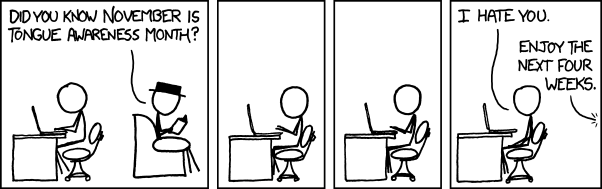
Apt cartoon by xkcd, about tongue awareness.