Saturday, March 31, 2012

Sensorimotor Obsessions: Hyperawareness of Body Sensations

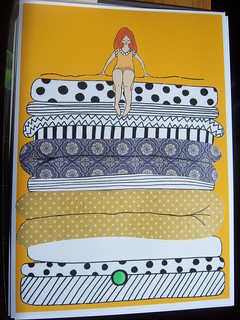
princess pea final 001

I have felt an affinity to the Princess who can feel the pea under all the mattresses in her bed. When I read David J. Keuler's article, When Automatic Bodily Processes Become Conscious: How to Disengage from "Sensorimotor Obsessions", I recognized myself. Here is Keuler's list of examples of Sensorimotor Obsessions:

  • breathing [whether breathing is shallow or deep, or the focus is on some other sensation of breathing]
  • blinking [how often one blinks or the physical requirement to blink]
  • swallowing/salivation [how frequently one swallows, the amount of salivation produced, or the sensation of swallowing itself]
  • movement of the mouth and/or tongue during speech
  • pulse/heartbeat [awareness of pulse or heartbeat, particularly at night while trying to fall asleep]
  • eye contact [unlike social anxiety-based concerns, this form involves awareness of the eye contact itself or which eye one is looking at when staring into the eyes of another person]
  • visual distractions [e.g. paying attention to “floaters”, the particulate matter that is drifting within the eye that is most visible when staring at a blank wall or awareness of subtle movements of the eyes, such as saccadic eye movements]
  • awareness of specific body parts [e.g. perception of the side of one’s nose while trying to read or, as in the cases of a young boy and older man, a hyper-awareness of particular body parts such as their feet or fingers respectively]
My health anxiety is linked in part to assuming what I am aware of is dangerous. Floaters in my field of vision were particularly hard to deal with because I was afraid it was serious, and then when the doctor said it wasn't, I was worried I'd be aware of the bits of gray squiggles forever, and haunted by them, and I obsessed about obsessing. Bladder sensations took up a lot of my mental space from an early age.

Keuler proposes treatment consisting of:
  • Helping the sufferer understand that awareness of automatic body processes is not dangerous
  • Exposure to the sensation and prevention of responses such as distraction.
  • Body Scan and Mindfulness, and learning to observe sensations without judgement(Jon Kabat-Zinn has detailed instructions for doing a body scan. I did them everyday for many years, and it helped expand my focus.)
He suggests post-it notes with reminds of the sensation in strategic locations, practicing inviting the sensation in rather than fleeing from it, which ultimately leads to less sensitivity to the sensations and/or greater tolerance of them. Before you panic at the thought of purposely evoking sensations you'd rather banish forever, remember that in actuality you can't perfectly set up the world to never remind you of your breathing, your tongue or your bladder.

I know that bliss when a sensation recedes and the agony of something reminding me of it, but it's the jolt of encountering the feeling reinforces the anxiety, making me wish I could ratchet down my life even more so that I never get surprised. It was liberating to discover that I could purposely face the sensation, and not have to tiptoe around my life.


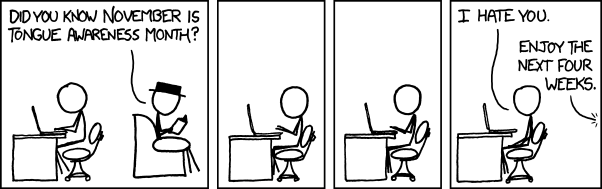
Apt cartoon by xkcd, about tongue awareness.

Monday, March 12, 2012

OCD: A Guide for the Newly Diagnosed: Review of Michael Tompkins' Book for Consumers


When New Harbinger Publications asked if I would consider reviewing Michael Tompkins book, OCD: A Guide for the Newly Diagnosed, I was heartened to know that there was a new book on this topic. The introduction is by Jeff Bell, who wrote an insightful memoir about OCD called Rewind, Replay Repeat, which I took to be a good sign.

The book fits nicely in the hand, and adds to the approachability for those who have just found out they have OCD. Actually, Tompkins starts with describing the process of getting a diagnosis, and I'm glad he addressed the difficulty of finding mental health professionals who are actually familiar with the many forms OCD can take. I would argue that the comprehensive diagnostic process described in this book really only happens with therapists who are specialists in OCD, or who have trained in Exposure Therapy, and have treated a lot of people with OCD. The therapist who diagnosed me basically said, yes, it sounds like you have OCD.

Tompkins does an overview of Exposure and Response Prevention Therapy(ERP), Cognitive Therapy, and medication as well as other treatments, as well as what questions to ask a potential therapist, and how to get the most out of sessions.

I particularly liked the chapter on developing a "Recovery Attitude" including accepting such things as uncertainty, imperfect outcomes, imperfect knowledge, learning to approach discomfort in order to get through to the other side, turning away from debate with your OCD, seeking support, not reassurance, and practicing everyday. As someone who has struggled with perfectionistic OCD, I constantly battled with the fear that I wasn't doing my treatment perfectly or that I didn't have perfect knowledge of my OCD. Tompkins points out that "good enough" treatment is indeed "good enough," and OCD is demanding perfection that doesn't exist.

The book closes with information about unhealthy coping, school and work issues, a list of treatment centers, and recommended reading. It's difficult to fit everything into an introductory book, an at times I wanted more detail, or found too much squeezed into a section, but overall this book would be an excellent addition to a public library's mental health collection, as well as college libraries and hospital consumer health libraries.

Michael Tompkins, PhD, is a licensed psychologist at the San Francisco Bay Area Center for Cognitive Therapy.


Sunday, February 19, 2012

Review the Young Adult Novel about OCD, Zelah Green: One More Little Problem


Vanessa Curtis's Zelah Green: One More Little Problem, is the next in this series about a teenage girl with OCD. The review copy came in the mail in the midst of my back going out, and I spent an afternoon in bed reading, which reminded me of much of my adolescence. Curtis has a good grasp of how stress can make rituals worse, and the double-edged sword of getting immediate relief of anxiety by doing the rituals, but the ultimate pain caused when they interfere with important things like friendship, love and family. I was moved by the description of Zelah holding her father's time for the first time since she was twelve, and how his skin felt.

Zelah's therapist, Stella, is concerned that Zelah is trying to take control of all the out of control things in her life during her summer "off"(which is anything but off from her anxieties), including her father being out of work, Caro from her time at Forest Hill showing up on the doorstep, and the most stable adult in her life, Heather, being out of the the country.
"Hmm," said Stella. "The thing is, Zelah, that none of the things happening in your house should really be your responsibility at all. I am not surprised your rituals are getting worse."
But for Zelah, calling her therapist if things get overwhelming seems alien. There's something about being that age, and just assuming that of course it's your responsibility, and the OCD compounding this by offering a glimpse of control, an illusion that if you do the rituals, the anxiety and fear will go away. Fortunately, Zelah also has friends, who help her make connections to both herself and to adults who can help.


Review of the first novel in the series:

Wednesday, February 8, 2012

Imperfection as Completion: What a Concept!

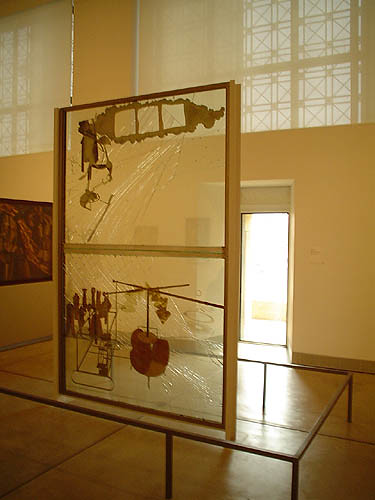
Marcel Duchamp sculpture, Philadelphia Museum of Art


Recently, I read about Marcel Duchamp's artwork at the Philadelphia Art Museum. The story goes that when he shipped it to the museum, the glass cracked in transit. When the museum told him about the damage he said, "Now it is complete." I've seen this Duchamp piece in the past, and I had assumed that the cracks were made intentionally, not because of an accident.

I started thinking about Duchamp's flexibility of mind, his willingness to accept what came his way. Most artists wouldn't have reacted like Duchamp I suspect. He was a pioneer in conceptual art, and was famous for putting a ready made urinal on display as sculpture. His art doesn't appeal to everyone, but I like this incorporation of imperfection into the whole.

I can just imagine that if I were Duchamp, and my perfectionistic OCD was in gear, I would've spent a lot of energy checking the cracks, visualizing how the piece looked before it broke and comparing it in my mind, reassuring myself that the fractures did enhance the piece, going over all the conversations with the museum curator verbatim, wondering if I really did believe the cracks completed the work, or whether I was a bad person for presenting myself as a conceptual artist when in fact I wasn't sure if it was truly conceptual. . .and on and on.

Checking perceived flaws consumed a lot of my time from my teens onward, from slightly off center buttons to one stitch bigger than the others or a tiny scratch. No matter how small the "flaw" it appeared huge in my mind, and took over my whole field of vision, and became all I saw. Exposures for this kind of perfectionism included wearing the shirt, and not checking the buttons, or listening to scripts I wrote about maybe never enjoying my item because of the scratch, that it would haunt me, and always be the first thing I saw, and then listening to it until I could tolerate it, and even accept it. Marcel Duchamp would've needed a script about whether art critics would degrade his work because the cracks were too disfiguring. . .but I don't think he had OCD, and there's even a photo of him standing proudly in front of the glass.

Monday, January 30, 2012

Participate in online surveys for research on OCD and family relationships via Case Western Reserve University

Amy Przeworski contacted me about posting a link to her online studies. Researchers at Case Western Reserve University are conducting two online studies about the relationships of individuals with OCD or hoarding. Each study involves completing questionnaires online about relationships, emotions and OCD. You must be at least 18 to participate. Those who participate may enter into a raffle for a Target gift card. The information gathered from this study may help to improve therapies for OCD.

For more information:

Individuals with OCD and/or hoarding:

http://filer.case.edu/~axp335/ocd.htm

Relatives and significant others of those with OCD and/or hoarding:

http://filer.case.edu/~axp335/famocd.htm


This study is being conducted by Amy Przeworski, a researcher in the psychology department at Case Western Reserve University.

Wednesday, January 18, 2012

Two Years of Exposing OCD

It's Exposing OCD's blog anniversary! I've been writing this blog for two years. I am grateful for all the readers who contribute to a rich community of comments, and for those who read these words, and go on to start their own blogs. My blog roll has gotten longer and longer, and this makes OCD less isolating and lonely.

November and December were a struggle, and I pulled inward. The darkness, the cold, my back pain and subsequently spending much of my time inside and alone, contributed to depression.
Fortunately, when I called my therapist, in the midst of this lowness, he encouraged me to realize I am a social being, even if I am introverted, that I need human contact, and I focused on getting out of the house and meeting with friends or going to networking events. I also found someone who gives lessons in the Alexander Technique, who is also an artist, like I am, and he has been helping me with my posture so that when I am in the studio I don't aggravate my back.

In the mix with all this, I did my breast self-exam and felt an unfamiliar lumpiness, and started into a cascade of "What's wrong with you? Maybe you are just hyper-sensitive to your body, and that means you are a bad person. Or maybe you have cancer, and it's all your fault. . ." and on and on. I was able to wait a week or two, and do my self-exam again, to make my best guess, since I still felt something, and make an appointment to see a doctor, not knowing for sure if it was OCD-warped perception, or something wrong.

The doctor couldn't feel anything. In the past, I would have had a panic attack about how stupid I was to go, or find another doctor to make sure. He did prescribe an ultrasound, and then my annual mammogram which came back normal. I have a follow-up appointment in February. That I can deal with potential health problems is really big, and as much as I hate the uncertainty, I know I have much more ability to cope with it. I am reading a book, Present Perfect, about perfectionism and the author says that if we are alive, we are all survivors of uncertainty. Uncertainty is all around us, but OCD hones in on certain ones, and says, "If you don't know this, you can't go on" but we go on all the time--we just don't realize it.