Sunday, February 19, 2012

Review the Young Adult Novel about OCD, Zelah Green: One More Little Problem


Vanessa Curtis's Zelah Green: One More Little Problem, is the next in this series about a teenage girl with OCD. The review copy came in the mail in the midst of my back going out, and I spent an afternoon in bed reading, which reminded me of much of my adolescence. Curtis has a good grasp of how stress can make rituals worse, and the double-edged sword of getting immediate relief of anxiety by doing the rituals, but the ultimate pain caused when they interfere with important things like friendship, love and family. I was moved by the description of Zelah holding her father's time for the first time since she was twelve, and how his skin felt.

Zelah's therapist, Stella, is concerned that Zelah is trying to take control of all the out of control things in her life during her summer "off"(which is anything but off from her anxieties), including her father being out of work, Caro from her time at Forest Hill showing up on the doorstep, and the most stable adult in her life, Heather, being out of the the country.
"Hmm," said Stella. "The thing is, Zelah, that none of the things happening in your house should really be your responsibility at all. I am not surprised your rituals are getting worse."
But for Zelah, calling her therapist if things get overwhelming seems alien. There's something about being that age, and just assuming that of course it's your responsibility, and the OCD compounding this by offering a glimpse of control, an illusion that if you do the rituals, the anxiety and fear will go away. Fortunately, Zelah also has friends, who help her make connections to both herself and to adults who can help.


Review of the first novel in the series:

Wednesday, February 8, 2012

Imperfection as Completion: What a Concept!

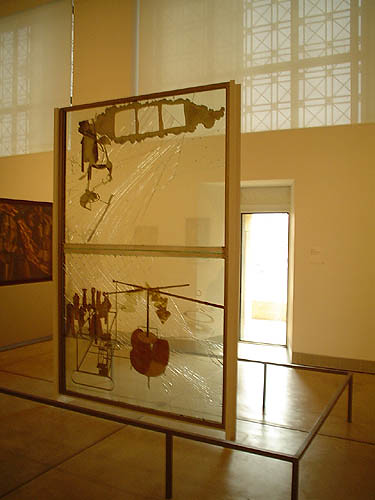
Marcel Duchamp sculpture, Philadelphia Museum of Art


Recently, I read about Marcel Duchamp's artwork at the Philadelphia Art Museum. The story goes that when he shipped it to the museum, the glass cracked in transit. When the museum told him about the damage he said, "Now it is complete." I've seen this Duchamp piece in the past, and I had assumed that the cracks were made intentionally, not because of an accident.

I started thinking about Duchamp's flexibility of mind, his willingness to accept what came his way. Most artists wouldn't have reacted like Duchamp I suspect. He was a pioneer in conceptual art, and was famous for putting a ready made urinal on display as sculpture. His art doesn't appeal to everyone, but I like this incorporation of imperfection into the whole.

I can just imagine that if I were Duchamp, and my perfectionistic OCD was in gear, I would've spent a lot of energy checking the cracks, visualizing how the piece looked before it broke and comparing it in my mind, reassuring myself that the fractures did enhance the piece, going over all the conversations with the museum curator verbatim, wondering if I really did believe the cracks completed the work, or whether I was a bad person for presenting myself as a conceptual artist when in fact I wasn't sure if it was truly conceptual. . .and on and on.

Checking perceived flaws consumed a lot of my time from my teens onward, from slightly off center buttons to one stitch bigger than the others or a tiny scratch. No matter how small the "flaw" it appeared huge in my mind, and took over my whole field of vision, and became all I saw. Exposures for this kind of perfectionism included wearing the shirt, and not checking the buttons, or listening to scripts I wrote about maybe never enjoying my item because of the scratch, that it would haunt me, and always be the first thing I saw, and then listening to it until I could tolerate it, and even accept it. Marcel Duchamp would've needed a script about whether art critics would degrade his work because the cracks were too disfiguring. . .but I don't think he had OCD, and there's even a photo of him standing proudly in front of the glass.

Monday, January 30, 2012

Participate in online surveys for research on OCD and family relationships via Case Western Reserve University

Amy Przeworski contacted me about posting a link to her online studies. Researchers at Case Western Reserve University are conducting two online studies about the relationships of individuals with OCD or hoarding. Each study involves completing questionnaires online about relationships, emotions and OCD. You must be at least 18 to participate. Those who participate may enter into a raffle for a Target gift card. The information gathered from this study may help to improve therapies for OCD.

For more information:

Individuals with OCD and/or hoarding:

http://filer.case.edu/~axp335/ocd.htm

Relatives and significant others of those with OCD and/or hoarding:

http://filer.case.edu/~axp335/famocd.htm


This study is being conducted by Amy Przeworski, a researcher in the psychology department at Case Western Reserve University.

Wednesday, January 18, 2012

Two Years of Exposing OCD

It's Exposing OCD's blog anniversary! I've been writing this blog for two years. I am grateful for all the readers who contribute to a rich community of comments, and for those who read these words, and go on to start their own blogs. My blog roll has gotten longer and longer, and this makes OCD less isolating and lonely.

November and December were a struggle, and I pulled inward. The darkness, the cold, my back pain and subsequently spending much of my time inside and alone, contributed to depression.
Fortunately, when I called my therapist, in the midst of this lowness, he encouraged me to realize I am a social being, even if I am introverted, that I need human contact, and I focused on getting out of the house and meeting with friends or going to networking events. I also found someone who gives lessons in the Alexander Technique, who is also an artist, like I am, and he has been helping me with my posture so that when I am in the studio I don't aggravate my back.

In the mix with all this, I did my breast self-exam and felt an unfamiliar lumpiness, and started into a cascade of "What's wrong with you? Maybe you are just hyper-sensitive to your body, and that means you are a bad person. Or maybe you have cancer, and it's all your fault. . ." and on and on. I was able to wait a week or two, and do my self-exam again, to make my best guess, since I still felt something, and make an appointment to see a doctor, not knowing for sure if it was OCD-warped perception, or something wrong.

The doctor couldn't feel anything. In the past, I would have had a panic attack about how stupid I was to go, or find another doctor to make sure. He did prescribe an ultrasound, and then my annual mammogram which came back normal. I have a follow-up appointment in February. That I can deal with potential health problems is really big, and as much as I hate the uncertainty, I know I have much more ability to cope with it. I am reading a book, Present Perfect, about perfectionism and the author says that if we are alive, we are all survivors of uncertainty. Uncertainty is all around us, but OCD hones in on certain ones, and says, "If you don't know this, you can't go on" but we go on all the time--we just don't realize it.

Saturday, December 17, 2011

OCD Workshops for Parents at the Child Mind Institute in New York City


The Child Mind Institute let me know that they are offering a series of workshops for parents of children with OCD, with the last three being in January, February and March, 2012. All of the workshops in the series are free and open to the public. Here's a description of their mission:
Our Obsessive-Compulsive Disorder Parent Support and Information Group workshop series covers a range of issues affecting children with obsessive-compulsive disorder (OCD) and their support networks, from navigating friendships and family gatherings to the ins and outs of treatment and medication. This program is an opportunity to gain invaluable skills and learn how to help your children take control of their condition and thrive. Below you'll find the dates and topics of the 2011-2012 workshops; descriptions to follow.
This series is brought to you by the Child Mind Institute's Intensive Pediatric OCD Program. All workshops are held at the Child Mind Institute headquarters located at 445 Park Avenue (with entrance on 56th Street), New York, NY 10022.
The Nuts and Bolts of Exposure Therapy
Speaker: Jerry Bubrick, PhD, Senior Director, Anxiety & Mood Disorders Center; Director, Intensive Pediatric OCD Program
Date: Tuesday, January 10, 2012
Time: 6:00PM - 7:30PM
Location: Fascitelli Board Room at the Child Mind Institute
At first glance, the treatment for a child with OCD can seem illogical and difficult—why would my child want to do exactly what she fears? In this workshop, Jerry Bubrick, PhD, Senior Director of the Anxiety & Mood Disorders Center and Director of the Child Mind Institute's Intensive Pediatric Obsessive-Compulsive Spectrum Disorders Program explains why exposure therapy is the gold standard in OCD treatment and how it works to alleviate the extreme anxiety a child experiences around his or her symptoms. He explains how to help your child face the "bully in the brain" head-on and regain control over his or her life.
Is Medication Part of the Answer? Medication Approaches to OCD
Speaker: Roy Boorady, MD, Senior Director of the Child Mind Institute's Psychopharmacology Center
Date: Tuesday, February 7, 2012
Time: 6:00PM - 7:30PM
Location: Fascitelli Board Room
When deciding how to best treat a child with OCD, it is important to be aware of all of the options. Treatment for children with OCD will often involve cognitive-behavioral therapy, medication, or a combination of the two. Roy Boorady, MD, Senior Director of the Child Mind Institute's Psychopharmacology Center and one of the nation's foremost experts in the psychopharmacological treatment of children and teens, discusses medication approaches to treating OCD. You'll gain a deeper understanding of when and how medication should be used in the treatment of OCD as well as the benefits and drawbacks of the different classes of medication available.
Real Stories: Parents Speak
Date: Tuesday, March 6, 2012
Time: 6:00 PM - 7:30 PM
Location: Fascitelli Board Room at the Child Mind Institute
Join us for a very special Q&A panel of parents who've successfully led their children through the challenges of OCD. They will share personal stories—their struggles as well as the successes—of raising a child with OCD. You'll have the opportunity to ask questions and gain insight into how you can help your child while maintaining balance in your life.