Monday, February 3, 2014

Avoidance is not Benign in OCD or for the Body

I did an exposure by calling a physical therapist about my shoulder pain.  Part of my health anxiety assuming I must know what is wrong with me, choose the right kind of therapy, and "know before knowing."  The PT said I have a frozen shoulder, which in part arises from avoiding moving a shoulder that is painful, and the more you avoid, the more stuck it gets.

What a metaphor for mindfulness, facing fears, doing exposure therapy for OCD!

Avoidance can bring on the very thing we fear:  anxiety, pain, suffering.

Of course, frozen shoulder is somewhat of a mystery, as to how it arises in the first place. Uncertainty stirs my OCD.

But I am proud of myself for choosing to do something, one step at a time, rather than continuing to wait until the "perfect " time to call and the perfect kind of professional(family doc, physiatrist, physical therapist, massage therapist, chiropractor).

What do you avoid?  What step can you take toward it?

Tuesday, January 21, 2014

One Word for the Year in Dealing with my OCD: Practice

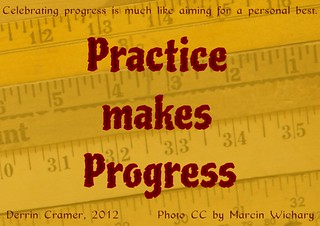
Practice Makes Progress

I assume I suck at practice.  Actually, I have amazing practice skills ~ practicing old rituals and patterns. I am going to a Mindfulness Meditation group, using the book Mindfulness: A Practical Guide to Finding Peace in a Frantic World by Mark Williams and Danny Penman.  The defining word is "practice."  Practicing being present.  Practicing being with my body sensations and all the attendant thoughts.

It's been a hard few months, with medical tests and uncertainty, with one problem receding and another advancing, and all the old health anxiety stuff surging up.  I knew I needed to do something to help take care of myself.

Check out the free mindfulness meditations on the Mindfulness site.

What would be your one word for the year, in dealing with your OCD?  A word that inspires you to make progress.

Friday, December 20, 2013

Behavioral and fMRI studies of cognition: A Chance to Participate in OCD Research before January 10, 2014


I posted information about this previously.  Mt. Sinai is closing their study by January 10, 2014, and still needs 2-3 more patients before then.

Behavioral and fMRI studies of cognition in healthy individuals and patients with anxiety

Study Description The current study is a neuroimaging study involving fMRI.  Specifically, we seek to examine the neural mechanisms underlying switching attention between internal thought, such as imagination,  and external stimuli.   

For OCD patients, participation consists of 2-3 sessions totaling 5-7 hours, and participants are reimbursed at $25 an hour.  The first session involves a clinical assessment and paperwork to confirm the patient's eligibility (~3 hours total), and the second session involves completing computer tasks while in the scanner (~2.5 hours total).  Payment is given to participants in cash upon completion of their participation.

Saturday, September 21, 2013

Doctors Can be Anxious Too


Doctors can be anxious too.  I have assumed that I am always the anxious one, and most other people are calm.  A month ago I went to see my family doctor about some body pain, and she gave me some medicine and told me to call her the next week to check in.  When I did, and I wasn't 100% better, she said to make a specialist appointment just in case it still wasn't gone the next week.  When I checked in again, and told her that my specialist appointment was October 21, she freaked out and said that was completely unacceptable, and I needed to be seen in the next 2 weeks.  This in turn ratcheted up my anxiety!  She also ordered a test for an ailment that would manifest pain in a different location, "just in case I had an atypical presentation."

My husband said, "Your doctor is anxious.  I don't know if that is good for you."  What we decided to do was have him do a search for treatment guidelines, rather than have me search, which is my primary compulsion with health anxiety.  I felt blessed to have someone who would help me get more information, but who would stop long before I would ever feel "done" if I was searching myself.

I got an earlier appointment with the specialist, who said the medicine hadn't had enough time to work, and that we could set aside the test for the unlikely ailment.  She did schedule a different test for October, but it was one my husband had found as the next step in the diagnosis process.

It's been a long week, with a dental appointment and a gynecology annual exam.  Preventive healthcare is important, but my OCD gets all stirred up.  Not to mention that I still don't feel good.  The challenge is to keep doing things important to me, even if I don't feel 100% or know what's wrong with 100% certainty.  Maybe my family doctor is right, and I have something unusual going on.  Maybe it's just that I live in a malpractice prone part of the country.  Maybe she lost someone to a disease and she never wants to lose someone again.

Sunday, August 25, 2013

OC87: A Movie About Courage and Living Your Life in the Midst of OCD


My husband was away, and I was feeling anxious.  I've come a long way since the time I walked 7 miles around a lake in order to ward off the anxiety of being alone for a week, but I'd been having physical aches and pains in the weeks leading up to his leaving, and my OCD was stirring.

Feeling achy and anxious, I started searching for movies on Netflix.  This was my way of avoiding searching for the meaning of my symptoms, but still, compulsive and exhausting.  Working my way through the alphabet and the numbers, using the arrow keys to navigate to one letter at a time.

Then OC87: The Obessive Compulsive Major Depression Bipolar Aspberger's Movie came up.  I remembered hearing about it when it came out a couple years ago, but I hadn't seen it.  It was already midnight, but I started watching.

Bud Clayman majored in film in college, but thoughts that scared him, and depression infiltrated his life.   OC87 refers to 1987 when he built his life around attempting to control the world around him, and the thoughts within him.

I was moved by Bud Clayman's persistence in making this film about his life now, after 30 years of OCD, depression and Asperger's, which involved dealing with people, dealing with his intrusive thoughts, indecision, anger and grief.  I particularly liked the scene he wrote where he played both "Good Buddy" and "Bad Buddy" in a riff on a scene from Lost in Space.  Part of this is in the trailer for the movie, the Bad Buddy telling the Good Buddy that he isn't capable of living without him, but Bud Clayman is capable of living his dream, even with the spectre of OC87, in the midst of the imperfections.

What this film reminded me was that to spend the week trying to figure out if my symptoms were a physical problem, or whether it was OCD, and freezing myself into a block of worry was a manifestation of my illness, and not what I want in my life.  

In one scene, Bud asks a woman what films she likes, and she asks him the same question, and his answer is that Ordinary People is the best movie ever made.  He describes how OC87 evolved out of a desire to describe how therapy had helped him, how it was a safe place, and how Ordinary People resonated with him, in its depiction of therapy.

Ordinary People is one of my favorite films, and I hadn't expected it to come up in Bud Clayman's film. I saw it when I was 12 or 13, several times, mesmerized.  Netflix had it, and I watched it next.  I'll write more about that.

Have you seen OC87?


Friday, August 16, 2013

Google Doesn't Have the Answer for Every OCD Fear

Uncertainty

This photo is called Uncertainty by Rieke Photography.  From the time I had access, over 20 years ago, I was searching on the internet for answers to my uncertainty.  I know the feeling of the keys under my fingers, the gentle give of each key when I depress it, the hope that I will get THE answer for my fears.

For a long time, I was glad I had dial-up because at least I was thwarted in compulsive web searching at home, even though I still had it at work.  The fact that I have high-speed internet at home now, and do not spend all my time searching, is quite amazing to me.  

In the thick of my OCD, before I got any treatment, I couldn't imagine stopping my searches.  If I had a health symptom, I searched for answers.  If I was trying to figure out an unanswerable question, I searched for answers.  I remember when Google first appeared.  I was a librarian, and word spread fast that there was this new search engine with a magical algorithm that worked exceedingly well.

But even Google couldn't solve my OCD, because the reassurance I was seeking was a mythical oasis that vanished as soon as I got close.  I will grant though that it was through Google that I found the International OCD Foundation.  I joined, and started receiving their newsletter.  The irony is that I subscribed to the newsletter for 5 years, all the while compulsively searching about OCD, instead of seeking treatment.

Eventually, when I reached my lowest point in 2006, I finally put it together that Exposure Therapy might work for my mental obsessions and health anxiety, and found an Exposure Therapist.

Part of my Exposure Therapy involved stopping a search before I felt "done" and staying with the wave of anxiety until it ebbed.  There are still days when I am feeling stressed, and search Google as a way to dull the anxiety, but it is not my default position, hands poised on the keyboard.


Wednesday, August 14, 2013

OCD is in the Realm of Human Experience: The Painfulness of Uncertainty

Recently, a dear friend of mine had a call-back at her annual mammogram screening.  We were having lunch and she told me how anxious she was.  The appointment was the next day, and her mind was spiraling into "what ifs."  She hadn't been sleeping.

I shared my experience with OCD, and some of what my exposure therapist had taught me, about the painfulness of uncertainty for humans, about how the present moment is the only functional moment, and that if something was wrong, she would deal with it when it happened.

I told her the story a friend had told me about a woman who had breast cancer, and then during a big storm a tree had fallen on her and killed her.

Then I felt bad for telling that story.  It's not very reassuring.  But it does get at the conundrum of being human, the inability to tell the future, the uncertainty even within the narrative of having breast cancer, where something else entirely can take you out.  And my friend understood this.  She knew I didn't want anything to happen to her, but that I did want her to be able to live her life.

I had a call-back after a mammogram several years ago, and the anxiety sucked.  The more I was able to bring myself back to the moment, the more I was able to cope.  Uncertainty is painful for humans, and the desire to race ahead and resolve things is strong.

There are times when what I am obsessing about coincides with fears of people around me, and they will reassure me that I "should" be worried, that it only makes sense.  But worry isn't protective, and can erode the very life we love and are afraid of losing.

My friend was fortunate to be at a mammogram center where the radiologist reads it while you wait, and it was fine.  This is compassionate care, mitigating what uncertainty can be mitigated.